If you are planning to launch a gummy supplement, one of the first questions you will probably ask a manufacturer is:
What is your minimum order quantity?
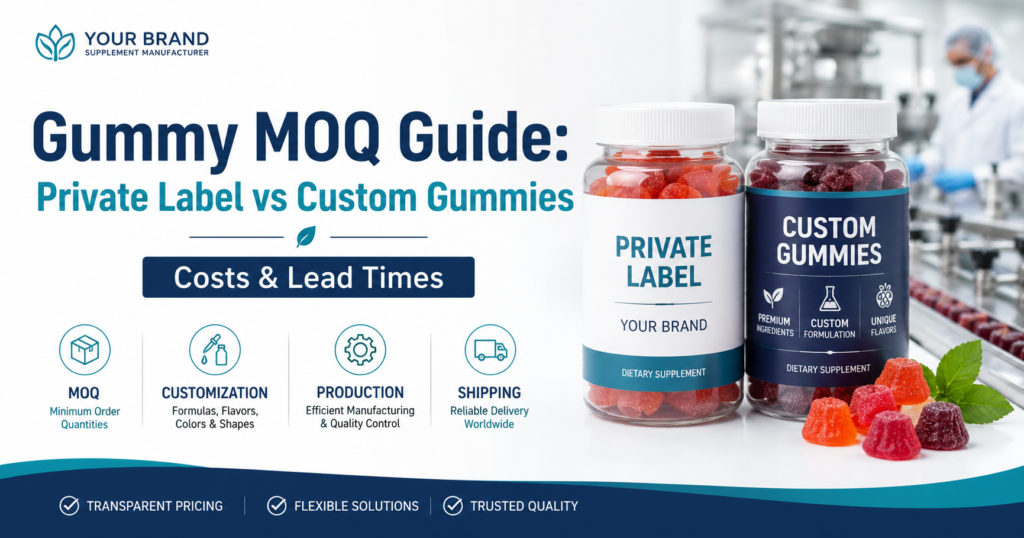
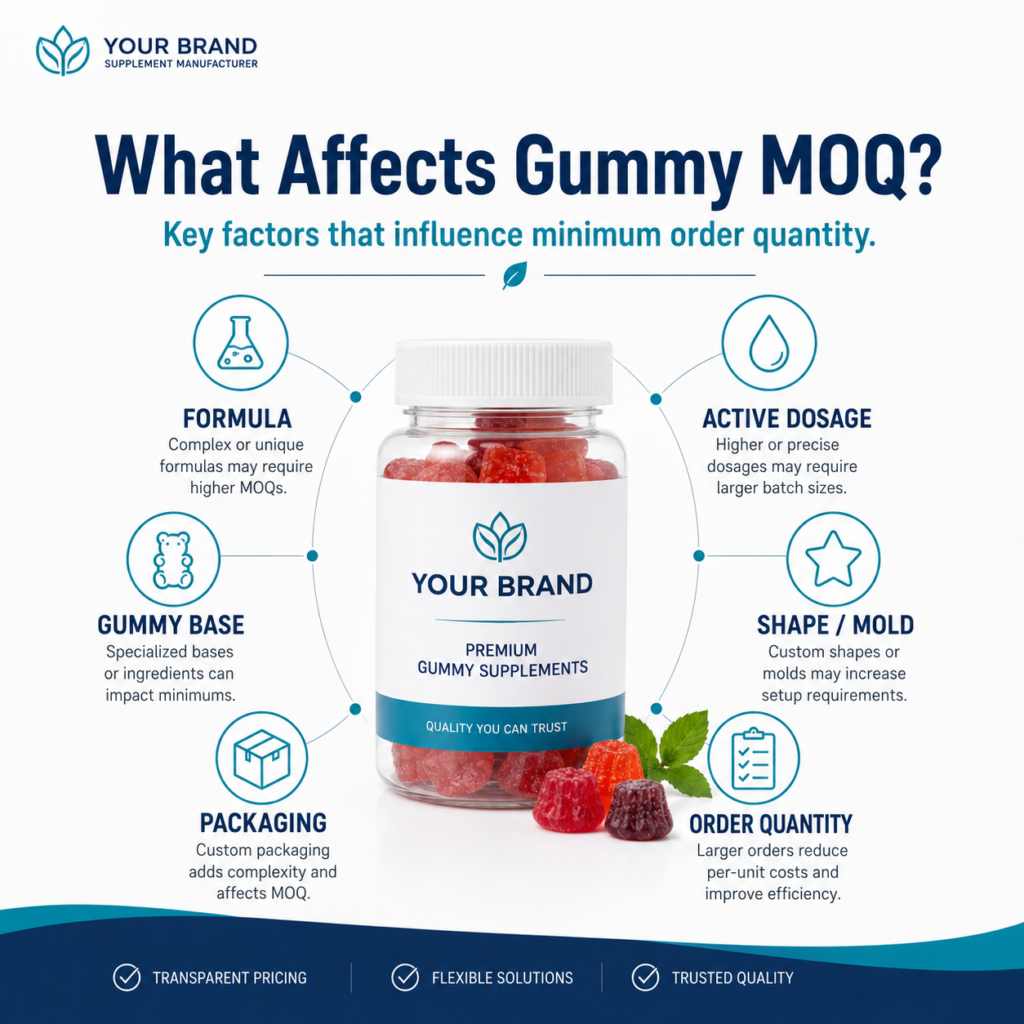
The answer may seem simple, but gummy MOQ is rarely determined by bottle quantity alone. Formula type, active ingredients, gummy base, shape, flavor, packaging, and the level of customization can all affect the minimum production quantity.
A private label gummy made from an existing formula may have very different requirements from a fully customized gummy with a proprietary formula, custom flavor, or unique mold.
This guide explains how gummy MOQ works, what can increase it, and how to choose between private label, semi-custom, and fully custom gummy manufacturing.
What Does Gummy MOQ Mean?
MOQ stands for Minimum Order Quantity — the smallest quantity a manufacturer can reasonably produce for a specific project.
For gummy supplements, MOQ may depend on several factors:
- Formula availability
- Active ingredient dosage
- Gelatin or pectin base
- Flavor and sweetness requirements
- Gummy size and weight
- Stock or custom mold
- Packaging format
- Label quantity
- Testing requirements
- Production line setup
This is why comparing gummy manufacturers based only on one MOQ number can be misleading.
A low MOQ may apply to an existing formula with standard packaging, while a fully customized gummy may require a larger production run.
The better question is not simply:
“What is your lowest MOQ?”
It is:
“What level of customization is available at this MOQ?”
Private Label vs Custom Gummies: Why MOQ Can Be Different
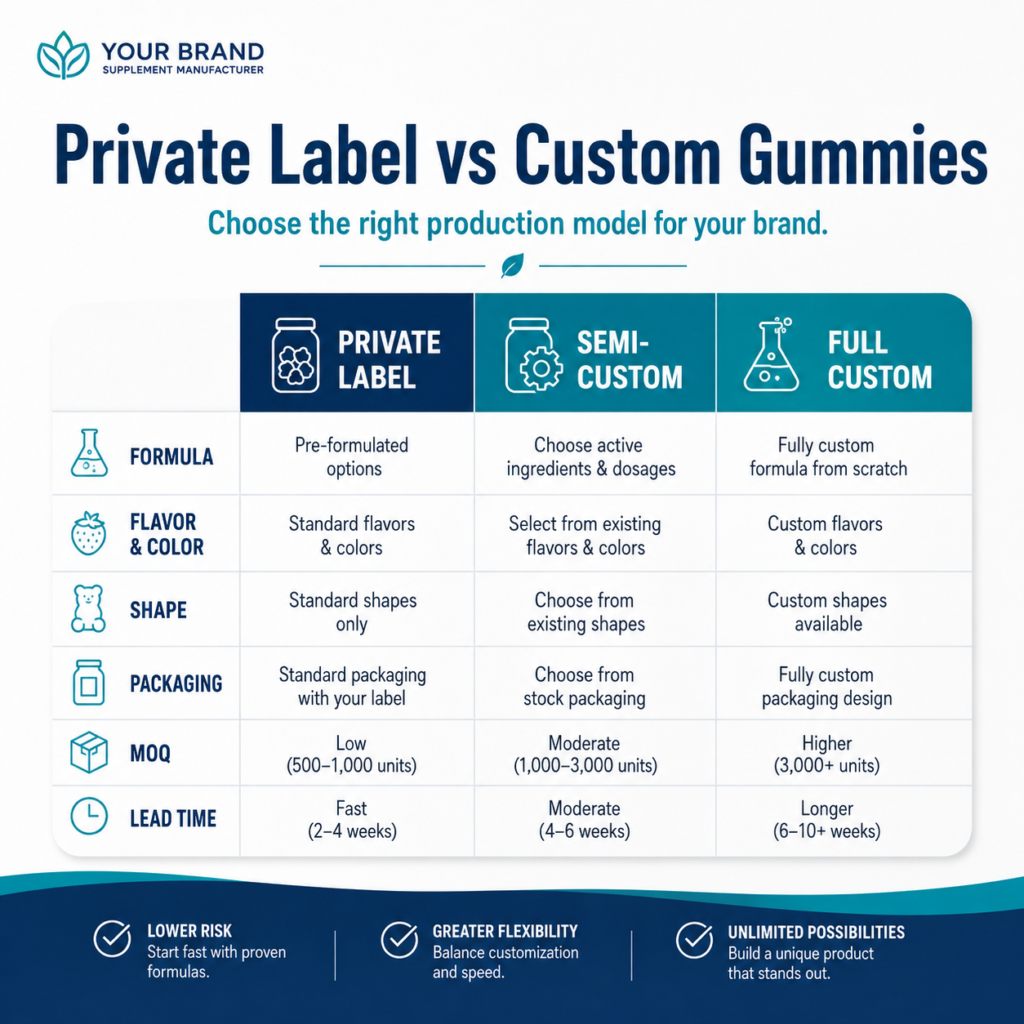
Gummy projects can generally be divided into three manufacturing models.
| Manufacturing Model | Formula | Flavor & Color | Shape | Packaging | Complexity |
|---|---|---|---|---|---|
| Private Label | Existing formula | Standard or limited options | Stock mold | Custom branding available | Low |
| Semi-Custom | Existing base with adjustments | Adjustable | Usually stock mold | Custom | Medium |
| Full Custom | Newly developed formula | Fully customized | Stock or custom mold | Fully customized | High |
Each option serves a different stage of brand development.
Private Label Gummies
Private label production usually starts with an existing formula or established manufacturing system.
Because the formula and production process already exist, brands may be able to reduce:
- Product development time
- Sampling rounds
- Ingredient sourcing complexity
- Production setup
- Initial inventory risk
For new supplement brands, this can be a practical way to launch faster and test market demand before committing to a larger custom production run.
Semi-Custom Gummies
Semi-custom manufacturing sits between private label and full customization.
A brand may begin with an existing gummy base and modify certain elements such as:
- Flavor
- Color
- Active ingredients
- Dosage
- Sweetener system
- Packaging
- Serving count
This option can be suitable for brands that want more differentiation without developing a completely new product from the ground up.
Fully Custom Gummies
A fully custom gummy project may involve:
- A proprietary formula
- New ingredient combinations
- Specific active ingredient dosages
- Custom flavor development
- Custom colors
- Vegan or specialty gummy bases
- Unique gummy shapes
- Custom packaging
The more variables that need to be developed, the more production planning, sampling, and testing may be required.
For this reason, fully customized gummy projects typically have different MOQ and lead-time requirements from stock private label products.
What Does “100 Bottles MOQ” Actually Mean?
Some gummy manufacturers offer private label programs starting at relatively low bottle quantities.
Honson Global currently supports eligible private label gummy projects starting from 100 bottles.
However, that does not mean every type of customization is automatically available at the same MOQ.
Lower-quantity projects are generally easier when they use:
- An existing formula
- Standard ingredients
- Existing gummy molds
- Standard bottle sizes
- Established flavor systems
- Existing packaging options
If you need a proprietary formula, custom mold, special ingredients, or completely customized packaging, the production requirements may change.
Before requesting a quote, ask the manufacturer:
Which parts of my gummy can be customized at this MOQ, and which changes would require a larger production run?
This gives you a much clearer picture than comparing suppliers based only on their advertised minimum order.
What Can Increase a Gummy Manufacturing MOQ?
Several decisions can increase the complexity of a gummy project.
1. Developing a New Formula
Creating a new gummy formula can require work on:
- Ingredient compatibility
- Active ingredient dosage
- Flavor masking
- Sweetness
- Texture
- Stability
- Color
- Moisture control
Unlike capsules or powders, gummy ingredients must work within a specific texture and structure.
A formula that looks straightforward on paper may still require multiple adjustments before it performs well in a gummy format.
2. High Active Ingredient Dosage
Higher dosages can affect more than just ingredient cost.
They may also influence:
- Taste
- Texture
- Gummy weight
- Piece size
- Stability
- Number of gummies per serving
For example, increasing the active ingredient load may make it harder to maintain an acceptable taste or texture.
That is why dosage should be discussed early in product development.
Instead of only saying:
“I want magnesium gummies.”
Provide the manufacturer with your target dosage per serving.
This makes formulation and quotation more accurate.
3. Gelatin vs Pectin Gummies
The gummy base can also affect formulation.
Gelatin Gummies
Gelatin is commonly used to create the traditional chewy gummy texture familiar to many consumers.
Pectin Gummies
Pectin is commonly selected for vegan or plant-based gummy products.
Sugar-Free Gummies
Sugar-free gummies may require different sweetener systems and additional formulation work to achieve the desired taste and texture.
Honson Global currently supports gelatin, pectin-based, and sugar-free gummy options depending on project requirements.
The right choice should be based on your target customer, product positioning, and formula requirements — not MOQ alone.
Stock Gummy Shapes vs Custom Molds
Using an existing gummy shape is usually simpler than developing a proprietary mold.
Common stock shapes may include:
- Bears
- Hearts
- Stars
- Fruit shapes
- Other standard designs
A custom mold may be appropriate when a brand wants:
- A unique product shape
- A brand symbol
- A logo-based gummy
- Stronger product differentiation
However, custom tooling can introduce additional:
- Development time
- Mold cost
- Sampling
- Production setup
For a new brand testing market demand, using an existing mold may be the more practical option.
Custom molds often make more sense once the product and sales channel have already been validated.
Packaging Can Have Its Own MOQ
One of the most common mistakes new supplement brands make is assuming:
Product MOQ = Packaging MOQ
They are not always the same.
Your gummy project may involve separate minimum quantities for:
- Bottles
- Caps
- Labels
- Printed pouches
- Cartons
- Display boxes
- Shrink sleeves
- Custom packaging components
For example, a manufacturer may be able to produce a relatively small gummy batch while a custom packaging supplier requires a larger print quantity.
Before confirming your order, ask for both:
Product MOQ
and
Packaging MOQ
This helps prevent unexpected packaging inventory or additional cost later.
Private Label Gummy MOQ vs Fully Custom Gummy MOQ
The lowest possible MOQ is not always the best choice.
Your ideal production model depends on where your brand is today.
If You Are Testing a New Product
A lower-MOQ private label product may make sense if you want to:
- Validate customer demand
- Test advertising
- Test Amazon or DTC sales
- Collect customer feedback
- Reduce initial inventory exposure
- Launch quickly
At this stage, an existing formula and stock mold can simplify the launch.
If You Already Have a Validated Product
Once demand has been proven, you may want to adjust:
- Dosage
- Flavor
- Ingredient combinations
- Serving count
- Packaging
- Brand positioning
A semi-custom approach can provide more differentiation without requiring a completely new development process.
If You Are Building a Long-Term Proprietary Product
Established brands may have stronger reasons to invest in:
- Proprietary formulas
- Unique ingredient combinations
- Custom gummy shapes
- Custom flavor systems
- Premium packaging
- Brand-exclusive specifications
At this stage, the goal is no longer simply finding the lowest MOQ.
The goal becomes creating a product that supports stronger differentiation and long-term brand value.
How Much Does It Cost to Manufacture Gummies?
There is no meaningful single price for gummy manufacturing.
The final cost depends on the complete product specification.
Some of the biggest cost drivers include:
| Cost Factor | Why It Matters |
|---|---|
| Active ingredients | Premium or high-dose ingredients can increase formula cost |
| Gummy weight | Larger gummies require more material |
| Gummies per serving | Affects total quantity required per bottle |
| Servings per bottle | Directly affects fill quantity |
| Order quantity | Production volume affects unit economics |
| Formula development | Custom formulas may require R&D and sampling |
| Custom mold | Proprietary shapes may require tooling |
| Packaging | Bottles, labels, pouches and cartons affect cost |
| Testing | Testing requirements vary by formula and target market |
| Freight | Shipping method and destination affect landed cost |
| Fulfillment | Storage and order fulfillment add operating costs |
Instead of asking:
“How much is one bottle of gummies?”
a better quote request should include:
- Target formula
- Active ingredient dosage
- Gummies per serving
- Servings per bottle
- Gummy type
- Estimated order quantity
- Packaging format
- Target market
The more complete your specifications are, the more accurate the quotation can be.
Serving Count Can Change Your Product Economics
Manufacturing cost per bottle is important, but it is not the only number that matters.
You should also consider:
Cost per serving
Changing from 30 servings to 60 servings can affect:
- Bottle size
- Product weight
- Shipping cost
- Retail price
- Consumer purchase barrier
- Repurchase frequency
- Subscription strategy
For example, a larger bottle may reduce the cost per serving but increase the retail price and upfront purchase commitment.
Serving count should therefore be considered during product development rather than after the formula is already finalized.
Related Guide:
Supplement Serving Count: 30, 60 or 90 Servings
How Long Does Gummy Manufacturing Take?
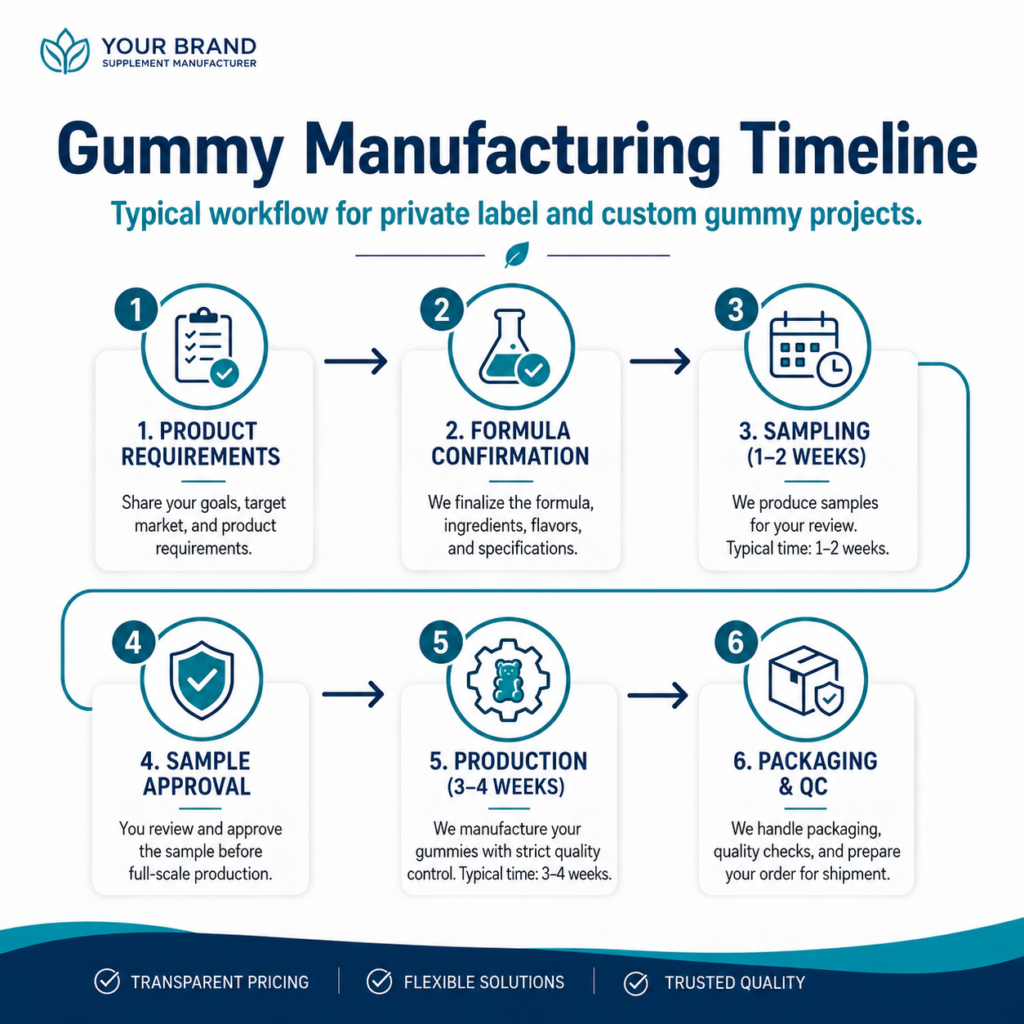
The production timeline depends on the level of customization and project complexity.
A typical gummy project may follow these steps.
Step 1: Product Requirement Review
The brand provides information such as:
- Target formula
- Active ingredient dosage
- Quantity
- Packaging
- Target market
Step 2: Formula Confirmation
The manufacturer reviews ingredient compatibility, dosage, and production feasibility.
Step 3: Sampling
Flavor, texture, color, and dosage can then be evaluated.
For Honson Global gummy projects, samples are typically prepared within approximately 1–2 weeks after formula confirmation.
Step 4: Sample Approval
The brand reviews and approves the final product specification.
Step 5: Production
Standard production currently takes approximately 3–4 weeks after sample approval, depending on project requirements and order quantity.
Step 6: Packaging and Quality Control
Finished products are packaged, inspected, and prepared for shipment or fulfillment.
Fully custom projects may require additional time for formulation development, packaging sourcing, or custom mold production.
How to Choose the Right MOQ for Your Gummy Brand
The best MOQ is not necessarily the smallest one.
The better question is:
How much inventory makes sense for your current business stage?
Consider a Smaller Initial Run If:
- You are launching your first SKU
- Sales demand has not been validated
- Customer acquisition cost is still unknown
- You are testing multiple flavors
- You want to validate packaging
- You want to reduce inventory risk
Consider a Larger Production Run If:
- Demand has already been validated
- You have repeat customers
- Your sales channels are established
- You understand inventory turnover
- Better unit economics justify additional inventory
- You are investing in proprietary customization
Inventory should support your sales strategy — not become the strategy itself.
Questions to Ask Before Requesting a Gummy Manufacturing Quote
A detailed RFQ helps your manufacturer evaluate the project faster and provide a more useful quotation.
Before contacting a gummy manufacturer, prepare answers to these questions.
1. What type of gummy do you want to manufacture?
Examples may include:
- Multivitamin gummies
- Magnesium gummies
- Creatine gummies
- Collagen gummies
- Sleep gummies
- Beauty gummies
- Electrolyte gummies
2. What is your target dosage?
Specify the amount of each active ingredient per serving whenever possible.
3. How many gummies per serving?
One, two, or more gummies per serving can significantly affect formula design and unit economics.
4. How many servings per bottle?
Decide whether your product should contain 30, 60, 90, or another number of servings.
5. Gelatin or pectin?
Consider whether vegan positioning is important for your target consumer.
6. Standard or sugar-free?
Sweetener requirements should be discussed during formulation.
7. Stock shape or custom mold?
A custom shape can strengthen differentiation but may require additional development.
8. What packaging do you need?
Specify:
- Bottle or pouch
- Label
- Carton
- Shrink sleeve
- Other packaging requirements
9. What quantity are you planning to order?
If possible, provide both your initial order quantity and expected future volume.
10. Where will the product be sold?
Your target market can affect labeling, documentation, testing, and product requirements.
The better your RFQ, the easier it is for the manufacturer to recommend the right production approach.
When Does Private Label Make More Sense Than Full Custom?
Private label may be a better fit when your priority is:
- Speed to market
- Lower initial inventory
- Lower product development complexity
- Testing market demand
- Launching your first product
Fully customized manufacturing may make more sense when your priority is:
- Product differentiation
- Proprietary formulation
- Brand exclusivity
- Unique consumer positioning
- Long-term competitive advantage
Neither option is automatically better.
A good manufacturing partner should help you select the production model that fits your current business stage rather than pushing every brand toward the most complicated solution.
Related Guide:
Private Label Supplement Manufacturing
How Honson Global Supports Gummy Supplement Projects
Honson Global supports private label and custom gummy manufacturing for supplement brands.
Current capabilities include:
- Private label gummy production
- Custom formulation
- Gelatin gummies
- Pectin-based vegan gummies
- Sugar-free options
- Stock gummy molds
- Custom gummy molds
- Custom flavors and colors
- Packaging support
- Batch COA traceability
- Warehousing and fulfillment support
Learn more about our gummy manufacturing capabilities:
Private Label Gummy Manufacturer →
Final Thoughts
Gummy MOQ should not be evaluated as a standalone number.
A 100-bottle private label project and a fully customized gummy product can involve very different production requirements.
Before choosing a manufacturer, understand:
- What is included in the MOQ
- What can be customized
- What increases production complexity
- How packaging affects minimum quantities
- How your inventory level fits your sales strategy
For a new brand, reducing inventory risk may be the priority.
For an established brand, formulation, differentiation, and unit economics may matter more than achieving the lowest possible MOQ.
The right manufacturing strategy is the one that fits your current stage of growth.
Ready to Discuss Your Gummy Project?
Planning a private label or custom gummy supplement?
To receive a more accurate recommendation, send us:
- Your formula or target ingredients
- Desired dosage
- Gummy type
- Gummies per serving
- Serving count
- Packaging requirements
- Estimated order quantity
- Target market
Our team can review your requirements and recommend an appropriate manufacturing approach.
Request a Gummy Manufacturing Quote →
Frequently Asked Questions
What is the minimum order quantity for private label gummies?
Honson Global currently supports eligible private label gummy projects starting from 100 bottles. The actual MOQ depends on the formula, packaging, and level of customization required.
Can I create a completely custom gummy formula?
Yes. Custom formulation can include ingredient selection, dosage development, flavor optimization, texture adjustments, and product sampling.
Can gummies be vegan?
Yes. Pectin-based gummies can be used for brands looking for a plant-based alternative to traditional gelatin gummies.
Can I manufacture sugar-free gummies?
Sugar-free options are available. Sweetener selection, taste, and texture should be evaluated during formulation development.
Can I create a custom gummy shape?
Yes. Existing molds are the simplest option for many projects, while custom molds can be developed for brands that require a proprietary shape.
How long does it take to receive gummy samples?
Samples are typically prepared within approximately 1–2 weeks after formula confirmation, depending on the project.
How long does gummy production take?
Standard production is typically around 3–4 weeks after sample approval, depending on order size and project requirements.
What information should I provide when requesting a gummy quote?
Provide your target formula, active ingredient dosage, gummy type, gummies per serving, servings per bottle, packaging requirements, estimated quantity, and target market.