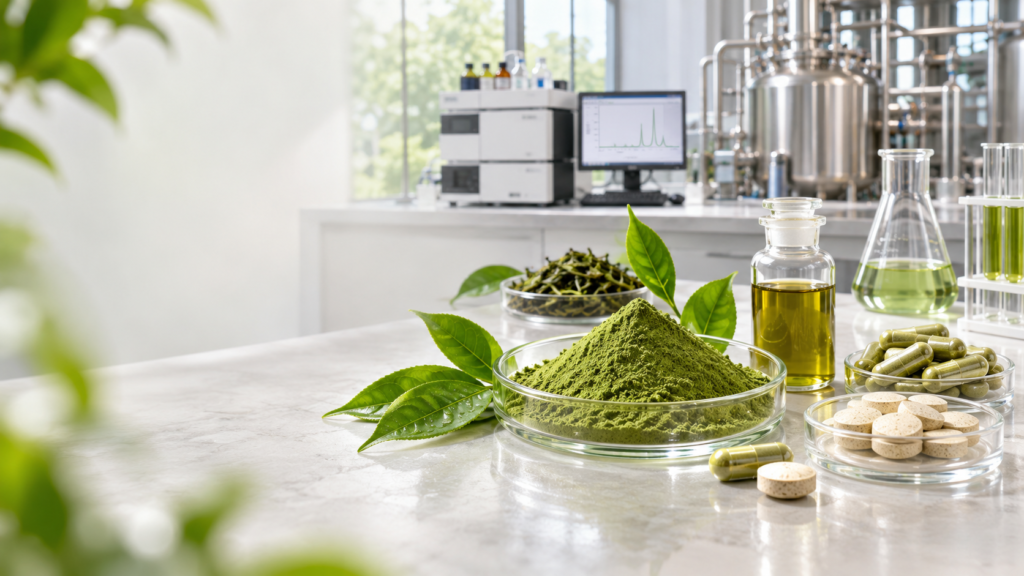
EGCG (Epigallocatechin Gallate) is a key catechin found in green tea and a commonly standardized component of green tea extracts used in dietary supplement development. For supplement brands, an EGCG supplement offers an opportunity to develop products with defined botanical extract specifications and flexible dosage formats.
Explore related product: Superfoods Greens Gummies with Multivitamins – 120 Count
However, developing an EGCG supplement involves more than selecting a green tea extract with a high EGCG percentage. For an EGCG supplement, extract standardization, catechin composition, caffeine content, raw material purity, formulation compatibility, and regulatory requirements all need to be considered before production.
For brands sourcing private label or custom supplements, the main challenge is ensuring that the ingredient specification matches the finished-product formula and target market requirements. This guide explains six important considerations for EGCG supplement OEM and ODM manufacturing, helping brands evaluate raw materials, select suitable dosage forms, establish quality controls, and prepare for commercial production. For regulatory background on green tea catechins, see the NIH Office of Dietary Supplements green tea fact sheet.
1. Understand EGCG Standardization Before Selecting Raw Materials
EGCG is one of the major catechins found in green tea extract. Commercial green tea extracts may contain different concentrations of EGCG and total catechins, depending on the botanical source, extraction process, and standardization method.
One important distinction is that EGCG percentage and total catechin percentage are not interchangeable. A supplier may advertise a high total catechin concentration without providing the same proportion of EGCG.
Before approving a raw material, brands should confirm the following:
- Botanical source and plant part used.
- Green tea extract ratio and extraction method.
- EGCG percentage and total catechin content.
- Caffeine content or caffeine-free specification.
- Residual solvent limits.
- Heavy metal and pesticide testing.
- Microbiological specifications and batch traceability.
The analytical method also matters. HPLC is commonly used to identify and quantify individual catechins, allowing buyers to evaluate EGCG content separately from other components.
The following table outlines the main specifications worth comparing.
| Quality Item | What Brands Should Confirm |
| Botanical identity | Camellia sinensis and declared plant part |
| EGCG content | Standardized percentage and analytical results |
| Total catechins | Individual catechin profile and total content |
| Caffeine | Actual content and agreed specification |
| Residual solvents | Results against applicable limits |
| Contaminants | Relevant heavy metals and pesticide testing |
| Documentation | Lot-specific COA and supplier traceability |
A higher EGCG percentage is not automatically a better purchasing decision. The appropriate specification depends on the intended serving, formula requirements, target market, and regulatory considerations.
Compare equivalent extract specifications rather than relying on the headline percentage alone.
2. Define the Formula and EGCG Amount Per Serving
Once the raw material is selected, the next step is to establish how much EGCG the finished supplement should provide per serving.
For example, an extract standardized to 50% EGCG and an extract standardized to 80% EGCG require different ingredient quantities to deliver the same amount of EGCG.
The basic calculation is:
EGCG Content = Green Tea Extract Quantity × EGCG Standardization Percentage
For a formulation containing 200 mg of an extract standardized to 50% EGCG, the calculated EGCG content is 100 mg.
This distinction should be clearly reflected in the formulation specification and relevant product documentation.
Before approving the formula, confirm:
- Green tea extract quantity per serving.
- EGCG quantity per serving.
- Total catechin content, where specified.
- Caffeine content and any caffeine-related requirements.
- Number of capsules or tablets per serving.
- Total servings per bottle.
- Applicable market-specific daily intake requirements.
For customized formulations, additional ingredients may affect raw material sourcing, manufacturing compatibility, testing, and labeling.
Brands should also ensure that the Supplement Facts panel accurately reflects the actual ingredient quantities and applicable declaration requirements.
A clear distinction between extract weight and EGCG content helps prevent inconsistencies between supplier quotations, formulation records, and finished-product labels.
3. Choose the Right Dosage Form for EGCG Supplements
EGCG can be developed into different supplement formats, but the choice depends on ingredient concentration, formulation characteristics, processing conditions, and the intended product experience.
Capsules and tablets are practical starting points for many standardized green tea extract formulations. Other formats may require additional development work.
| Dosage Form | Key Manufacturing Considerations |
| Capsules | Extract flowability, fill weight, moisture control, and uniformity |
| Tablets | Compression properties, ingredient compatibility, and disintegration |
| Powders | Taste, dispersibility, moisture protection, and packaging |
| Gummies | Bitterness, color stability, heat exposure, and active ingredient compatibility |
| Liquids | Solubility, pH, oxidation, and formulation stability |
Capsules offer flexibility in ingredient loading and are suitable for many standardized botanical extract formulas. Tablets require additional attention to compression properties and the compatibility of excipients.
Powder formats may be considered for brands developing drink mixes or customized botanical blends. However, EGCG’s sensory characteristics, including bitterness and color, should be evaluated during formulation.
Gummies and liquid products can present additional challenges. Processing temperature, pH, moisture, and ingredient interactions may affect the final product’s quality and stability.
For this reason, brands should not assume that an existing capsule formula can be transferred directly into a gummy or liquid format.
Select the dosage form according to the actual formulation requirements and available manufacturing technology.
4. Establish Quality Control and Stability Testing
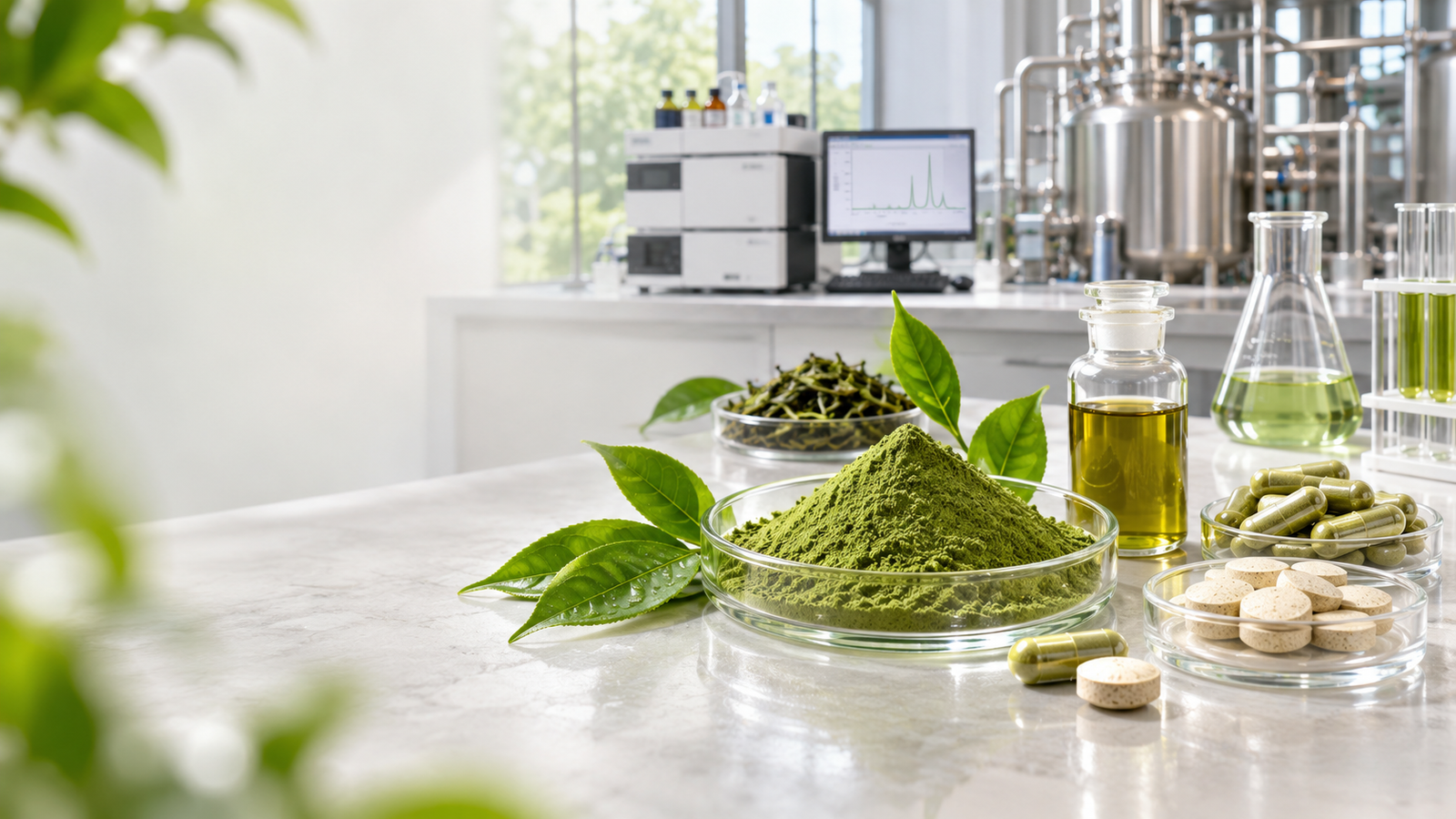
Green tea extract standardization is only one part of EGCG supplement quality control. The manufacturing process must also maintain ingredient consistency and finished-product specifications.
Raw material testing should verify the declared EGCG concentration and other relevant quality parameters before the ingredient is approved for production.
During manufacturing, important controls may include:
- Raw material identity and specification verification.
- Ingredient weighing and batch record review.
- Blending uniformity and dosage consistency.
- In-process production inspections.
- Finished-product testing and quality release.
- Batch identification and traceability.
Stability is another important consideration. EGCG-containing extracts may be sensitive to environmental and formulation conditions, so the development team should evaluate the effects of moisture, oxygen, temperature, light, and pH where relevant.
Packaging selection should be considered as part of the stability strategy rather than treated as a separate design decision.
A practical testing plan may include the following:
| Testing Area | What to Evaluate |
| Identity and potency | EGCG concentration and relevant catechin profile |
| Caffeine | Compliance with the approved specification |
| Heavy metals | Applicable contaminant limits |
| Residual solvents | Compliance with relevant specifications |
| Microbiology | Applicable finished-product requirements |
| Uniformity | Consistency of ingredient distribution |
| Stability | Changes in relevant quality parameters over time |
Brands should request a lot-specific COA and clarify which tests are performed internally and which are conducted by third-party laboratories.
A COA confirms selected results at a particular testing stage. It does not independently establish the proposed shelf life. Stability studies should use defined methods, storage conditions, and acceptance criteria.
See Honson Global’s Understanding Supplement COAs & Third-Party Testing for additional guidance on supplier documentation and quality verification.
5. Review Regulatory Requirements Before Entering Your Target Market
EGCG supplement development requires particular attention to market-specific requirements because green tea extracts containing EGCG are subject to additional regulatory conditions in the European Union.
For the U.S. market, dietary supplements must comply with applicable FDA requirements, including current good manufacturing practices under 21 CFR Part 111. Ingredient identity, product specifications, labeling, and marketing claims should be reviewed before launch.
Brands should also evaluate whether the specific ingredient and manufacturing history raise any New Dietary Ingredient (NDI) considerations.
Structure/function claims require appropriate substantiation and must comply with applicable FDA notification and disclaimer requirements. Disease treatment or prevention claims should not be used to position a dietary supplement as a drug.
The European Union has additional restrictions for green tea extracts containing EGCG under Commission Regulation (EU) 2022/2340.
For applicable products, the regulation establishes the following requirements:
- The daily portion must contain less than 800 mg of EGCG from green tea extracts.
- The label must state the EGCG content per portion.
- The maximum number of daily portions must be indicated.
- Specific warnings concerning daily intake, other green tea products, pregnancy and lactation, children under 18, and consumption on an empty stomach must be included.
These requirements should be reviewed against the exact product category and current applicable legislation before a product is marketed in the EU.
Official reference: https://eur-lex.europa.eu/eli/reg/2022/2340/oj
For brands selling across multiple markets, one label should not automatically be reused for every destination. Ingredient specifications, daily serving design, warnings, and claims should be reviewed separately for each market.
Regulatory review should happen during formulation development, not after the packaging artwork has been approved.
6. Plan MOQ, Packaging, and Production Before Ordering
MOQ and production costs depend on more than the amount of EGCG extract used in a formula. Dosage form, ingredient specifications, production requirements, packaging customization, and testing scope can all influence the final quotation.
Before requesting a manufacturing proposal, brands should prepare a clear product brief.
| Project Requirement | Information to Prepare |
| Ingredient | EGCG percentage and green tea extract specification |
| Formula | Target EGCG content and serving size |
| Dosage form | Capsules, tablets, powders, gummies, or liquids |
| Target market | United States, EU, or other destinations |
| Packaging | Bottle, jar, pouch, label, and carton preferences |
| Order quantity | Estimated initial MOQ and future volume |
| Testing | COA, potency, contaminants, and stability requirements |
Packaging selection is particularly important for standardized botanical extracts. Moisture protection, container closure performance, and appropriate storage conditions should be considered according to the formulation and stability data.
For capsules and tablets, bottles with suitable moisture protection may be considered. Powder products may require packaging with appropriate moisture barriers and closure systems.
Brands should also clarify whether the quotation includes sampling, formulation adjustments, packaging materials, printing, testing, and finished-product documentation.
Production timelines depend on raw material availability, formula approval, sample revisions, packaging procurement, manufacturing scheduling, and quality release.
An existing formula with standard packaging may involve less development work than a customized EGCG blend or specialized dosage form. Confirm the actual MOQ and lead time for the complete project rather than relying on general estimates.
Discuss Your EGCG Supplement Project With Honson Global
Honson Global supports supplement brands through OEM and ODM manufacturing, ingredient sourcing, formulation development, packaging, and quality control across multiple supplement formats.
For an EGCG supplement project, the first step is to define the extract specification and intended finished-product requirements.
To help evaluate your project, prepare:
- Target EGCG percentage and green tea extract specification.
- Desired EGCG quantity per serving.
- Preferred dosage form.
- Caffeine content requirements.
- Target market and proposed label positioning.
- Estimated initial order quantity.
- Packaging and testing requirements.
If you have an existing reference product, share its ingredient specifications and label details. This gives the development team a clearer starting point for evaluating formulation feasibility, manufacturing options, and project scope.
MOQ, ingredient availability, testing requirements, and production timelines should be confirmed for the specific project before an order is placed.
Frequently Asked Questions
1.What is the difference between EGCG and green tea extract?
Green tea extract is a botanical ingredient containing multiple catechins and potentially caffeine. EGCG is one specific catechin within that extract. Brands should distinguish the total extract quantity, total catechin content, and actual EGCG content when reviewing ingredient specifications.
2.What EGCG standardization should brands choose?
There is no single standardization level suitable for every product. The appropriate specification depends on the intended formula, serving size, target market, ingredient documentation, and regulatory requirements. Brands should compare actual EGCG content rather than extract percentages alone.
3.Can EGCG be manufactured into gummies or capsules?
Capsules and tablets are practical formats for many standardized green tea extract formulas. Gummies may require additional formulation work to address bitterness, color, processing conditions, and stability. The final format should be selected after technical feasibility testing.
4.What quality documents should I request from an EGCG supplier?
Request a lot-specific COA, botanical identity documentation, EGCG assay results, catechin profile where relevant, caffeine specification, and applicable contaminant and residual solvent testing. Additional documentation should reflect the ingredient’s origin and risk profile.
5.What determines the MOQ for a private label EGCG supplement?
MOQ depends on dosage form, extract specifications, ingredient availability, production setup, packaging, and customization requirements. A standard capsule formula may have different production requirements from a customized gummy or liquid formulation.
Final Thoughts
Developing an EGCG supplement requires careful coordination between extract standardization, serving design, dosage form selection, quality control, packaging, and regulatory compliance.
For supplement brands, the most important starting point is a clearly defined ingredient specification. Understanding the difference between EGCG content and total green tea extract, establishing appropriate testing requirements, and reviewing target-market regulations can help reduce avoidable development changes.
Choosing an OEM or ODM partner with suitable formulation and quality management capabilities provides a stronger foundation for moving from ingredient sourcing to commercial production.