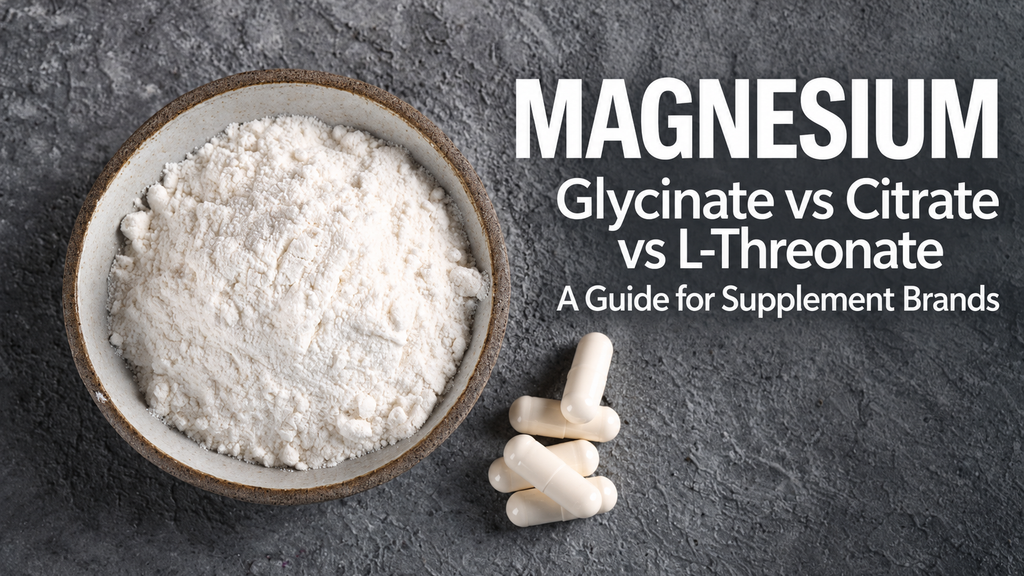
Magnesium Glycinate vs Citrate vs L-Threonate: A Supplement Brand’s OEM Guide
Explore related product: Liposomal Magnesium Liquid Packets
Comparing magnesium glycinate vs citrate for a private label supplement? Adding magnesium L-threonate to the shortlist introduces further questions about ingredient specifications, serving size and sourcing.
The decision affects more than the ingredient name on your label. It determines how much raw material your formula needs, whether that material fits the intended dosage form and what the finished serving costs.
For supplement brands, the right starting point is a defined product brief—not a claim that one magnesium form is best for everyone. Here is how to compare the three options for private label magnesium supplements and custom manufacturing projects.
Magnesium Glycinate vs Citrate: Quick Comparison of the Three Forms
Magnesium glycinate vs citrate (plus L-threonate) compares different magnesium compounds. Their names alone do not establish the exact specification, elemental magnesium content or performance of a finished product.
| Comparison Point | Magnesium Glycinate / Bisglycinate | Magnesium Citrate | Magnesium L-Threonate |
|---|---|---|---|
| Ingredient identity | Clarify whether the material is bisglycinate, buffered or a blend | Confirm the exact grade and hydration state | Confirm material identity, specification and supplier |
| Elemental magnesium | Verify the declared assay and full composition | Verify assay against the supplied grade | Calculate delivery using the actual material specification |
| Formulation review | Assess fill volume, processing and taste where relevant | Assess fill volume, mixing behavior and taste | Assess material loading and practical serving size |
| Sourcing questions | Request composition and support for chelation descriptions | Request identity, assay and relevant physical specifications | Review evidence relevance, sourcing rights and market conditions |
| Cost comparison | Compare equivalent materials and elemental delivery | Compare equivalent grades and finished servings | Include any applicable branded-material or supply requirements |
Use this table to shortlist materials, then evaluate the actual supplier grades. It is not a ranking of clinical effectiveness.
1. Define Elemental Magnesium Before Comparing Magnesium Glycinate vs Citrate
One of the most common specification problems in a magnesium glycinate vs citrate comparison is confusing compound weight with elemental magnesium. “1,000 mg magnesium glycinate” does not mean the product provides 1,000 mg of magnesium.
Your development brief should identify:
- Target elemental magnesium per serving
- Magnesium source or sources
- Material required per serving
- Preferred number of capsules, tablets or gummies
The basic calculation is:
Ingredient weight required = target elemental magnesium ÷ elemental magnesium fraction
For example, a hypothetical material containing 10% elemental magnesium would require 2,000 mg to provide 200 mg elemental magnesium. That is a calculation example, not a specification for any particular form.
Use the supplied material’s verified specification when calculating your formula. Include other active ingredients and processing aids when assessing total serving weight.
A quotation is not comparable unless the elemental magnesium target and ingredient composition are clear.
2. Magnesium Glycinate vs Citrate: Look Beyond the Ingredient Name
Magnesium glycinate and magnesium bisglycinate are frequently used in commercial descriptions. For procurement, request the precise material identity. A key question is whether the proposed ingredient is an unbuffered bisglycinate material, a buffered preparation or another blend.
Buffered vs Unbuffered Magnesium Glycinate
A buffered material may include an additional magnesium source, such as magnesium oxide. This can change the elemental magnesium percentage and the composition of the finished formula. “Buffered” does not automatically mean unsuitable. It means the material should be evaluated and represented accurately.
Ask for:
- Complete composition
- Elemental magnesium assay
- Relevant identity testing
- Support for the proposed chelation description
- Other components or carriers
Do not assume two quotations are equivalent because both use the phrase “magnesium glycinate” — a core risk in any magnesium glycinate vs citrate review. For a capsule project, also confirm how much of the specified material fits within the preferred serving. A formulation requiring several large capsules may not match the brand’s intended consumer experience.
3. Magnesium Citrate: Evaluate the Finished Formula
Magnesium citrate is an established magnesium source. The NIH Office of Dietary Supplements identifies citrate among the forms generally absorbed more completely than magnesium oxide and magnesium sulfate. That comparison does not establish a universal ranking against glycinate or L-threonate.
For manufacturing, focus on the proposed grade and how it performs in your product, not a generic magnesium glycinate vs citrate verdict.
For capsules and tablets, review ingredient volume and processing requirements. For powders, evaluate:
- Mixing and dispersibility
- Sedimentation
- Flavor and mouthfeel
- Moisture sensitivity
- Performance at the intended serving concentration
A raw material’s solubility description does not guarantee a clear or pleasant finished drink. Test the complete formula with the intended flavors, sweeteners and other ingredients before approving it.
4. Magnesium L-Threonate: Match the Material to Its Evidence
Magnesium L-threonate may be considered for a differentiated magnesium product, but unlike a simple magnesium glycinate vs citrate choice, ingredient identity, evidence and market access should be reviewed separately.
Ask whether the proposed material matches the ingredient described in the supporting research. Check the studied preparation, amount, population and outcomes before developing claims. If a branded ingredient is specified, confirm authorized supply and permitted trademark use.
Also calculate the elemental magnesium and total material weight per serving. The amount needed must fit the proposed product format and directions.
For EU projects, review applicable novel food conditions and permitted mineral-source requirements. A safety assessment does not mean that every supplier’s material can be used without restrictions.
Do not transfer claims or research from one proprietary preparation to another material without justification.
5. Choose According to Your Product’s Main Constraint
Instead of asking which magnesium form is universally best, identify what your project needs to achieve — a magnesium glycinate vs citrate decision follows your constraint.
| Project Requirement | First Development Priority |
|---|---|
| A limited capsule count | Calculate ingredient volume, bulk density and total fill |
| A flavored drink powder | Test the complete formula’s taste and mixing behavior |
| A chewable gummy | Evaluate mineral loading, piece size, texture and stability |
| A differentiated branded product | Confirm supply rights, evidence relevance and market conditions |
| A cost-controlled daily supplement | Compare finished cost at equivalent elemental magnesium delivery |
| A multi-form magnesium complex | Define the contribution and purpose of each source |
This approach turns a broad ingredient debate into a practical development decision. A multi-form blend is not automatically better because it lists more sources. The proportions, serving requirements and supporting rationale still matter.
6. Confirm That the Dosage Form Can Deliver the Specification
Magnesium supplement manufacturing requires the ingredient choice — whether from a magnesium glycinate vs citrate review — and dosage form to work together.
Capsules and Tablets: For a magnesium capsule formulation, assess fill weight, bulk density, capsule dimensions and units per serving. For tablets, evaluate compression behavior, tablet size and appropriate finished-product performance. Theoretical ingredient calculations should be followed by formulation and production assessment.
Powders: Consider serving weight, taste, mixing instructions and packaging protection. The formulation should be evaluated under the preparation conditions customers will actually use.
Gummies: A magnesium gummy formulation needs to balance ingredient delivery with flavor, texture and practical serving size. Do not promise a high elemental magnesium amount in a small serving before development confirms feasibility.
Our supplement format guide explains how dosage form affects manufacturing decisions.
7. Compare Finished-Serving Cost, Not Only Price per Kilogram
A lower raw material price does not necessarily produce a lower finished-product cost, especially in a magnesium glycinate vs citrate comparison. Request comparable quotations covering:
- The same elemental magnesium target
- Clearly defined material specifications
- Units per serving and servings per container
- Additional ingredients
- Sampling and development
- Testing and documentation
- Packaging and order quantity
Calculate the material cost needed to deliver the agreed serving, then include manufacturing and packaging requirements. If a supplier proposes an alternative grade or blend, request a revised specification before comparing prices. Keep the reason for the change visible: lower cost, reduced serving size or another requirement. Each alternative needs its own evaluation.
8. Agree on Quality and Market Requirements
Before production, define the ingredient and finished-product specifications, testing scope and release documents. Depending on the project, relevant checks may include identity, magnesium content, microbiological quality, contaminants and dosage-form performance.
Confirm which records relate to the commercial batch. Our supplement COA and third-party testing guide explains the main documentation questions.
Review shelf-life support alongside the intended packaging. A formula or packaging change may require additional evaluation. Finally, check ingredient permissions, proposed daily amounts, warnings and claims for the destination market before approving artwork.
Develop Your Magnesium Supplement With Honson Global
Honson Global’s magnesium capsule range and magnesium tablet range provide starting points for private label and custom project discussions.
To request a useful formulation and quotation review, send:
- Target market and consumer group
- Preferred magnesium source or blend
- Target elemental magnesium per serving
- Dosage form and preferred units per serving
- Servings per container
- Packaging requirements
- Estimated quantity
Our team can review the magnesium glycinate vs citrate requirements and discuss suitable manufacturing options. Formula availability, MOQ, sampling, testing, pricing and lead times should be confirmed for the specific project.
Frequently Asked Questions
Is magnesium glycinate better than citrate for every private label product?
No. A magnesium glycinate vs citrate decision compares the actual materials against your elemental magnesium target, dosage form, evidence requirements and commercial brief.
Are magnesium glycinate and bisglycinate always identical materials?
Commercial naming can vary. Request the exact identity and composition rather than treating the names as a complete specification.
Does a higher elemental magnesium percentage mean higher quality?
Not by itself. Review composition, identity, assay and suitability for the formula. A higher percentage may reflect a different material or blend.
Can glycinate, citrate and L-threonate be combined?
Potentially, subject to formulation feasibility and market requirements. Define how much each contributes and why it is included.
What information is most important for an initial quotation?
Provide the elemental magnesium target, material preference (from your magnesium glycinate vs citrate evaluation), dosage form, serving configuration, packaging, market and order quantity.
Further Reading
- NIH Office of Dietary Supplements — Magnesium
- EFSA — Magnesium L-Threonate Safety and Bioavailability Assessment
- European Commission — Magnesium L-Threonate as a Source in Food Supplements