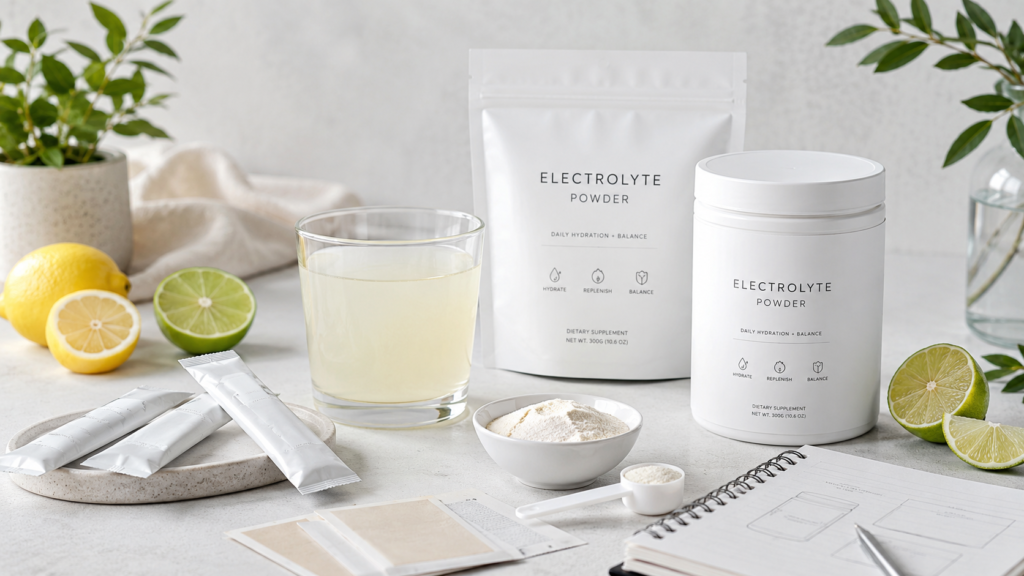
What It Really Takes to Launch an Electrolyte Powder Brand
Launching an electrolyte powder brand looks straightforward until the real product decisions begin. For brands planning a private label electrolyte powder, the real challenge is balancing formula, flavor, packaging, MOQ and target cost.
What minerals should be included? Should the formula be sugar-free? Which flavor will work with the mineral profile? Is a stick pack worth the extra packaging cost? How much customization makes sense for the first production run?
These decisions are closely connected.
A higher mineral load may make flavor development harder. Premium stick packs can improve presentation but may also increase MOQ and packaging cost. Adding more functional ingredients can strengthen the concept while also making the formula more expensive and more difficult to balance.
For most brands, the best place to start is not the ingredient list.
It is the customer.
Start With the Customer, Not the Formula
“Electrolyte powder” describes a category. It does not define the finished product.
A hydration powder for endurance athletes may look very different from one designed for travelers, office workers, wellness consumers or casual gym users.
Your target customer will influence:
- Mineral profile
- Serving size
- Sweetness
- Flavor direction
- Packaging format
- Price point
- Label positioning
A performance-focused product may prioritize mineral levels and functionality.
A lifestyle hydration brand may care more about clean taste, convenience and attractive single-serving packaging.
A family-oriented product may require a different serving size, flavor profile and ingredient approach altogether.
Before contacting an electrolyte powder manufacturer, try to describe the product in one clear sentence.
For example:
We want to develop a sugar-free electrolyte powder for active adults in the US market, packed in single-serving stick packs, with a light citrus flavor.
That gives a formulation team far more useful direction than simply saying:
We want to make an electrolyte powder.
A clear product brief reduces unnecessary back-and-forth later.
You May Not Need a Fully Custom Formula
New brands often assume that a fully custom formula is automatically the best option.
In practice, it depends on how important the formula is to your brand positioning.
There are usually three practical routes.
| Route | What It Means | Best For |
|---|---|---|
| White Label | Existing formula with your branding | Faster market entry |
| Private Label | Existing formula with selected changes | Moderate differentiation |
| Custom OEM | Formula developed around your brief | Brands with a specific product concept |
For a first launch, an established base formula with selected changes to flavor, ingredients or packaging can be more practical than developing everything from zero.
A fully custom formula makes more sense when the formulation itself is a major part of the product story.
The goal is not to make the product as complicated as possible.
It is to create enough differentiation to support the brand while keeping the project commercially realistic.
The Formula Has to Work in Water
Electrolyte formulas commonly include sodium and potassium, while magnesium, calcium and other minerals may also be considered depending on the product concept.
The challenge is that minerals affect taste.
A formula can look strong on a specification sheet and still be difficult to drink.
Higher mineral levels can introduce salty, bitter or metallic notes. Some ingredients may also affect solubility, mouthfeel or the amount of powder required per serving.
A common development challenge is trying to combine:
- A strong mineral profile
- Very little or no sugar
- A light fruit flavor
- A small serving size
Each request sounds reasonable on its own.
Together, they can be difficult to balance.
That is why electrolyte formulation and flavor development should not be treated as separate jobs.
At Honson Global, we prefer to review the formula, flavor direction and packaging requirements together at the early stage of a powder project. This makes it easier to balance product positioning, taste, serving size, MOQ and target cost before production begins.
Some brands also add ingredients such as:
- Vitamin C
- B vitamins
- Coconut water powder
- Amino acids
- Trace minerals
- Other functional ingredients
These additions can help create a more distinctive product, but each one may affect taste, cost, serving size and formulation complexity.
More ingredients do not always mean a better product.
Sugar-Free Sounds Simple. Formulating It Is Not.
Sugar-free electrolyte powders are popular across sports nutrition and daily wellness.
But removing sugar changes more than the nutrition panel.
Sugar can help balance saltiness, acidity and bitterness. Once it is reduced or removed, mineral notes may become much more noticeable.
That makes the sweetener system important.
Depending on the formulation and target market, brands may consider options such as stevia, monk fruit or other sweetening systems.
No single option works best in every electrolyte formula.
The final taste depends on the mineral profile, acidity, flavor system and target sweetness.
For most projects, it is more efficient to evaluate sweetness and flavor during sampling rather than approve the mineral formula first and try to fix the taste later.
Flavor Development Deserves More Attention Than Most Brands Give It
Electrolyte powder is usually a repeat-use product.
That means taste has a direct impact on whether customers actually want to use it again.
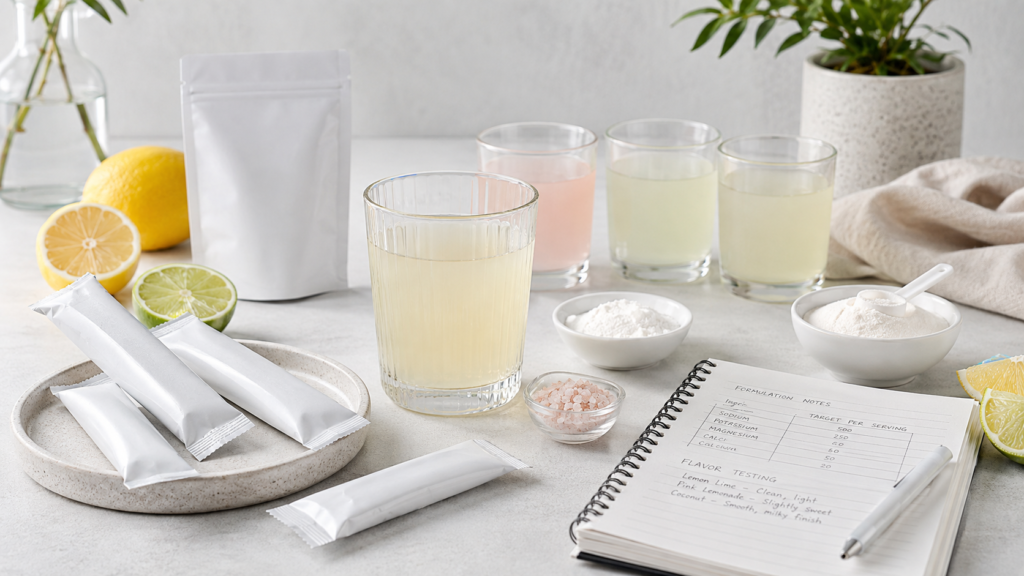
Choosing “lemon lime” or “watermelon” is only the beginning.
The formulation team still needs to balance:
- Saltiness
- Bitterness
- Sweetness
- Acidity
- Aroma
- Aftertaste
- Mouthfeel
Two lemon-lime electrolyte powders can taste completely different depending on the mineral system underneath them.
A first sample may be technically fine but slightly too sweet, too acidic or too mineral-forward.
Small adjustments at this stage are normal.
They are also much easier to make before printed packaging and bulk production are approved.
Do You Need Four Flavors at Launch?
Not necessarily.
For a new brand, launching one or two strong flavors can be easier to manage than producing four or five SKUs immediately.
More flavors mean more samples, more packaging versions and more inventory to manage.
Once you know which flavors customers actually reorder, expanding the range becomes a much easier decision.
Packaging Is Not Just a Design Choice
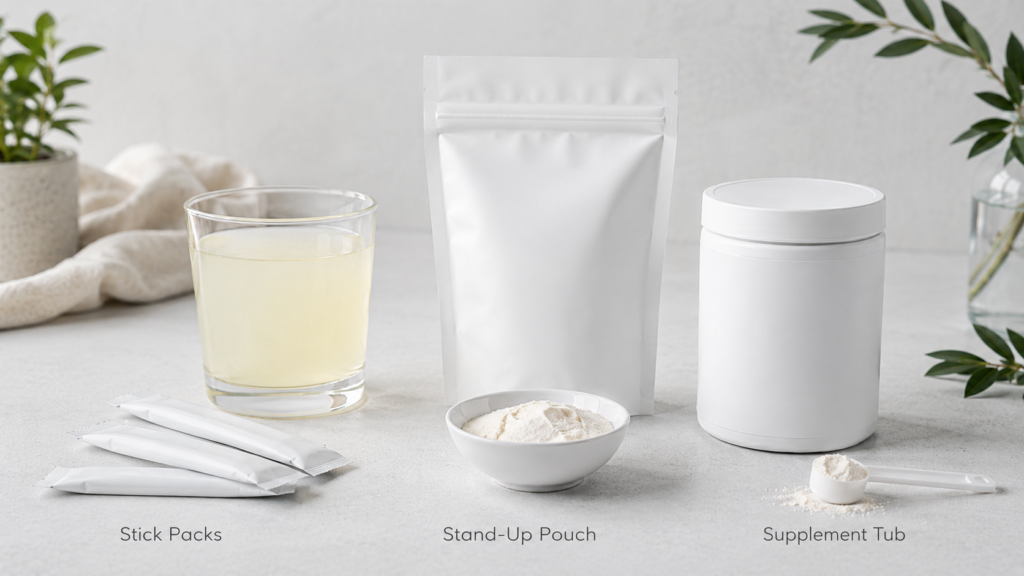
Packaging affects how the product is used, how it is positioned and how much it costs to produce.
For electrolyte powders, the most common formats are stick packs, pouches and tubs.
Stick Packs
Often used for:
- Travel
- Gym bags
- On-the-go hydration
- Sampling
- Variety packs
- Premium DTC products
Single-serving stick packs are convenient and easy to carry, but printed film and retail boxes can affect MOQ and packaging cost.
Pouches
Often used for:
- Daily use
- Repeat customers
- Larger serving counts
- Brands looking for a more economical packaging format
Pouches can work well when convenience matters, but individual serving packs are not essential.
Tubs
Often used for:
- Sports nutrition
- Gym-focused products
- Larger serving sizes
- Higher-volume use
There is no single best packaging format.
A DTC brand, Amazon seller, retail product and gym-focused brand may all make different packaging decisions even if the formula is similar.
Discuss packaging early. It can influence both the quote and the minimum production quantity.
MOQ Depends on the Whole Project
One of the first questions buyers ask is:
What is your MOQ?
There is rarely one useful answer without knowing the project details.
MOQ can be affected by:
- Formula customization
- Raw materials
- Flavor development
- Packaging format
- Printed packaging
- Number of flavors
- Number of SKUs
A stock formula packed into a standard container is usually simpler than a fully customized formula in printed stick packs with custom retail boxes.
This is why two electrolyte powder manufacturers can give very different MOQ numbers.
They may not be quoting the same type of project.
Honson Global supports powder projects in formats including jars, pouches, stick packs and sachets. The most accurate MOQ can usually be determined after the formula and packaging requirements are clear.
For new brands, the best first order is not always the order with the lowest unit price.
It is the order size that gives you enough inventory to test the market without putting too much cash into stock before demand is proven.
Sampling Is Where the Product Becomes Real
A formulation document tells you what is in the product.
A sample tells you what the customer will actually experience.
During sampling, you can evaluate:
- Solubility
- Sediment
- Mineral taste
- Sweetness
- Flavor strength
- Aftertaste
- Performance at different water volumes
A typical development process may look like this:
Product Brief → Formula Proposal → Flavor Development → Sample → Feedback → Adjustment → Final Approval
More customized products may need more than one sample round.
That is not unusual.
The purpose of sampling is to resolve taste and formulation issues before bulk production.
If you already have a benchmark product, competitor sample or reference formula, sharing it with the manufacturer can make the first development discussion much more efficient.
A Better Quote Starts With a Better Product Brief
You do not need a finished formula before contacting an OEM manufacturer.
But the more useful information you provide, the more useful the first quote will be.
A good starting brief includes:
- Target country or market
- Target customer
- Product positioning
- Sugar-free, low-sugar or other preference
- Key ingredients
- Benchmark or reference product
- Preferred flavor
- Serving size
- Packaging format
- Units per box or container
- Estimated order quantity
- Target cost or retail price
- Expected launch date
Even if some details are still undecided, this information gives the manufacturer a much better starting point.
If you already have a competitor product or reference formula, you can also send it for an initial feasibility review.
Price Matters, but Manufacturing Control Matters Too
A low quote does not tell you how consistently the product will be produced.

Before selecting a private label electrolyte powder manufacturer, ask about:
- Raw material verification
- Batch records
- Finished-product testing
- Microbiological testing
- Heavy metals
- Potency testing where applicable
- Certificates of Analysis
- Batch traceability
For products entering the U.S. market, brands should also review the FDA’s current good manufacturing practice requirements for dietary supplements.
The exact testing program depends on the formula and target market.
What matters is understanding the quality-control process before production starts.
This becomes more important as the brand grows.
Moving an existing product to another manufacturer later can mean repeating flavor work, packaging setup, samples, testing and qualification.
Choosing a supplier that can support both the first order and future scale can save a lot of work.
Look at Landed Cost, Not Just Powder Cost
The powder price is only one part of the finished-product cost.
A more realistic calculation may include:
- Formula Development
- Raw Materials
- Flavor
- Packaging
- Printing
- Testing
- Cartons
- Freight
- Duties
- Fulfillment
Landed Cost
Packaging can make a noticeable difference.
The same electrolyte formula packed into a pouch may have a very different finished cost from the same formula packed into individual printed stick packs and a retail box.
This is why sharing your target retail price or target landed cost early can be useful.
It gives the manufacturer a clearer idea of how much flexibility there is in the formula, serving size and packaging.
A small adjustment made early can be much easier than trying to reduce cost after the product is already finalized.
One Common Launch Scenario
Imagine a new brand wants:
- Four flavors
- A completely custom electrolyte formula
- Premium stick packs
- Custom retail boxes
- A low first-order quantity
- A very aggressive target cost
None of those requests are unusual.
The challenge is trying to achieve all of them in the same first production run.
A more practical launch may be:
Start with two flavors.
Use a strong base formula with selected customizations.
Keep the premium stick-pack format.
Test the market.
Expand the flavor range after sales data is available.
This does not make the product less professional.
It simply puts the budget into the parts of the product that matter most at launch.
A good OEM partner should help you decide what is worth customizing now and what can wait until the second production run.
How Long Does an Electrolyte Powder Project Take?
Project timing depends mainly on the level of customization.
An existing formula with standard packaging can usually move faster.
A fully custom formula with several flavor rounds and custom printed packaging will naturally take longer.
For Honson Global powder projects, standard production is typically around 3–4 weeks after samples and production details are approved, although the complete timeline depends on the formula, packaging and order quantity.
If you are working toward an Amazon launch, retail launch, trade show or seasonal campaign, share the target date early.
A realistic timeline is easier to build when the manufacturer knows the deadline from the start.
Artwork and packaging approvals are also common sources of delay, so they should not be left until the last minute.
Choosing the Right Electrolyte Powder Manufacturer
A good electrolyte powder manufacturer should do more than blend powder and fill packaging.
The manufacturer should be able to help you connect the major parts of the project:
Formula
→ Flavor
→ Serving Size
→ Packaging
→ MOQ
→ Testing
→ Production
→ Delivery
This is where Honson Global approaches electrolyte powder projects differently.
We do not treat formulation, flavor development and packaging as completely separate decisions.
For custom and private label powder projects, we review them together so brands can make practical trade-offs before production begins.
Depending on the project, Honson Global can support:
- Existing formulas
- Semi-custom formulas
- Fully custom OEM formulations
- Flavor development
- Stick packs
- Sachets
- Pouches
- Jars
- Testing
- Commercial production
That gives brands room to choose the level of customization that fits the stage of the business.
Planning Your Own Electrolyte Powder?
You do not need to have every detail finalized before speaking with a manufacturer.
If you already have a product idea, benchmark formula or packaging reference, send us the basic project information.
Include your:
- Target market
- Formula direction
- Preferred flavor
- Packaging format
- Estimated order quantity
Our team can review the project and help you evaluate the most practical route for formulation, sampling, packaging and production.