Private Label Supplement Manufacturing: How to Launch Your Brand
Launching a supplement brand can be exciting—but turning a product idea into a market-ready product involves far more than choosing a formula and adding a label. For most new brands, private label supplement manufacturing is the fastest route from product concept to a finished, saleable product.
You need to consider ingredients, dosage form, flavor, packaging, quality control, regulatory requirements, inventory planning, international shipping, warehousing, and order fulfillment. A dependable private label supplement manufacturing partner can guide you through each of these decisions in the right order, so nothing is forgotten between concept and launch.
When each step is handled by a different supplier, communication becomes complicated and mistakes become more likely.
That is why many growing supplement brands choose to work with an end-to-end supply chain partner that can coordinate the entire process—from initial product development to final customer delivery.
In this guide, we explain the key stages of launching a private label supplement and how to build a supply chain that can support your brand as it grows.
Table of Contents
1. Start With a Clear Product Concept
Before requesting a quotation, define the basic direction of your product.
You do not need to have a finished formula, but you should understand who the product is for and what problem it is designed to address.
A useful product brief may include:
- Target customer
- Product category
- Preferred ingredients
- Dosage form
- Serving size
- Flavor preferences
- Packaging format
- Target order quantity
- Destination market
- Target retail price
- Preferred launch date
For example, instead of requesting “a hydration supplement,”provide a clearer description:
A sugar-free electrolyte powder for active adults, available in individual sachets, with an initial order of 3,000 boxes.
This helps the development team evaluate ingredients, production requirements, packaging options, estimated costs, and launch timelines.
Not every detail needs to be finalized at the beginning. A professional manufacturing partner should help turn your initial idea into a practical product specification.
How Private Label Supplement Manufacturing Works
Private label supplement manufacturing follows a repeatable sequence: product brief, formula selection or development, sampling, packaging and label design, pre-production approval, manufacturing, quality testing, and fulfillment. Understanding the sequence helps you plan your budget and timeline realistically.
The first step in private label supplement manufacturing is choosing whether to use an existing formula or develop a custom one. Existing formulas are faster and more cost-effective; custom formulas give you exclusive rights to a product concept.
Once the formula direction is confirmed, the manufacturing partner produces a sample. After you approve the sample, packaging materials are finalized, a pilot batch may be produced, and the full production run begins.
Throughout the process, documentation matters. A professional private label supplement manufacturing partner maintains batch records, certificates of analysis, and inspection reports that protect you in every market where the product is sold.
2. Choose the Right Manufacturing Model
There are three common ways to launch a supplement product.
White Label Supplements
White label products use an existing, production-ready formula. They are often the entry point into private label supplement manufacturing for first-time founders.
You select the product, packaging, and branding while the manufacturer handles production.
This model is often suitable for brands that want to:
- Enter the market quickly
- Test a new product category
- Reduce development costs
- Start with a more manageable order quantity
- Validate demand before investing in customization
Because the formula has already been developed, the sampling and production process is generally more straightforward.
Private Label Supplements
Private label supplement manufacturing provides more flexibility.
Depending on the product, you may be able to customize:
- Flavor
- Sweetness
- Serving size
- Ingredient dosage
- Bottle or pouch format
- Label design
- Product count
- Outer packaging
Private label supplement manufacturing can help a brand create a more distinctive product without developing everything from the beginning.
Custom Formula Manufacturing
Custom formulation is designed for brands that want a product built around a specific audience, positioning, or ingredient concept.
A custom project may include:
- Unique ingredient combinations
- Specialized serving sizes
- Custom flavors
- Vegan or plant-based requirements
- Sugar-free options
- Allergen-related requirements
- Branded packaging systems
- Market-specific specifications
Custom products usually require more sampling and development, but they can create stronger differentiation and improve long-term brand value.
Key Benefits of Private Label Supplement Manufacturing
Private label supplement manufacturing is popular because it shortens time to market. Instead of building your own production facility, you leverage an existing factory, its equipment, its quality systems, and its regulatory experience.
- Launch in weeks instead of the years required to build a facility
- Test multiple formulations with a much smaller capital commitment
- Scale production up or down as demand changes
- Access formulation and compliance expertise on demand
- Focus your team on brand building instead of factory operations
For most emerging brands, private label supplement manufacturing offers the best balance of speed, cost, and control. It is also the model that most contract manufacturers recommend to first-time founders.
3. Select the Right Dosage Form
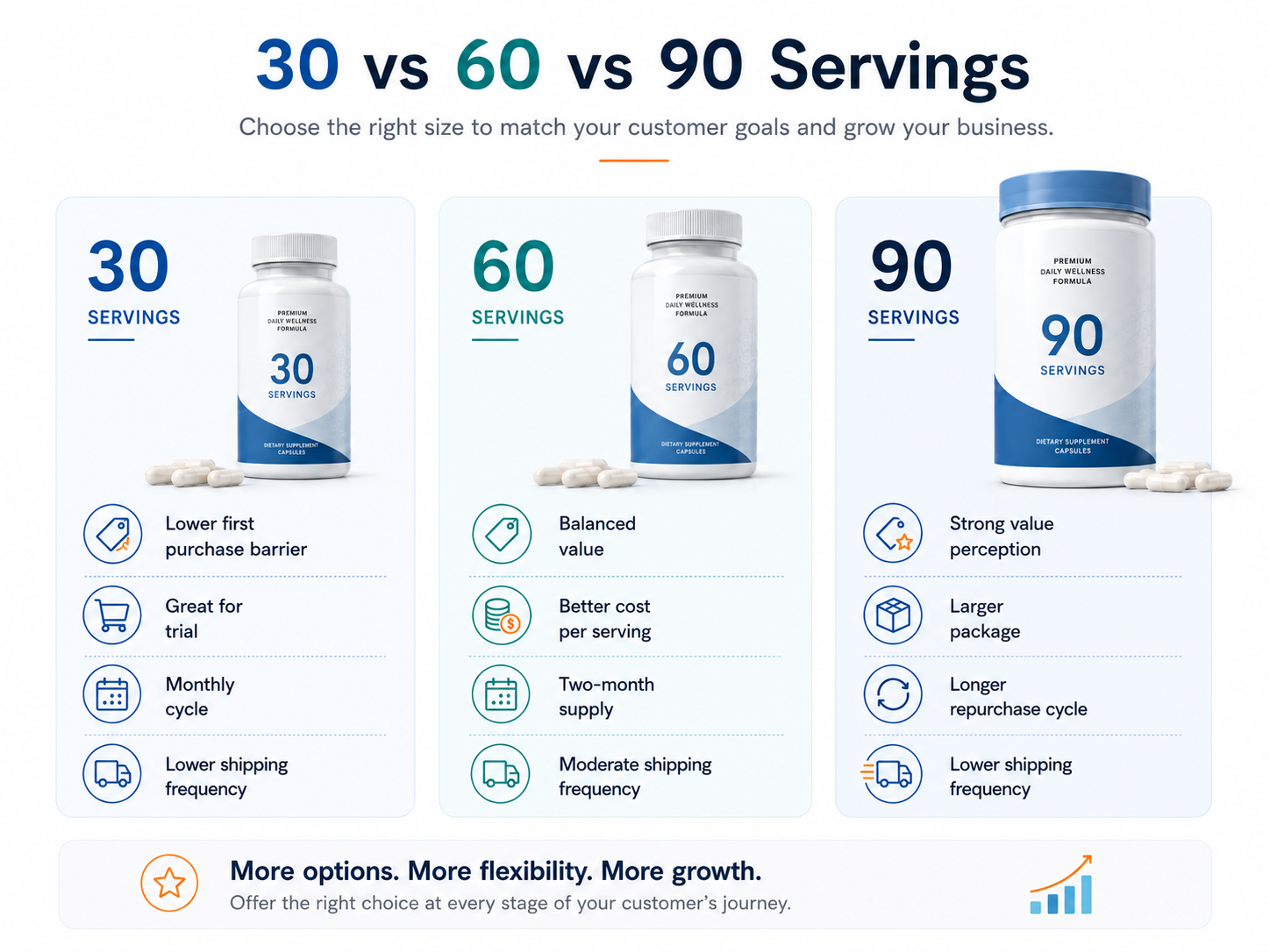
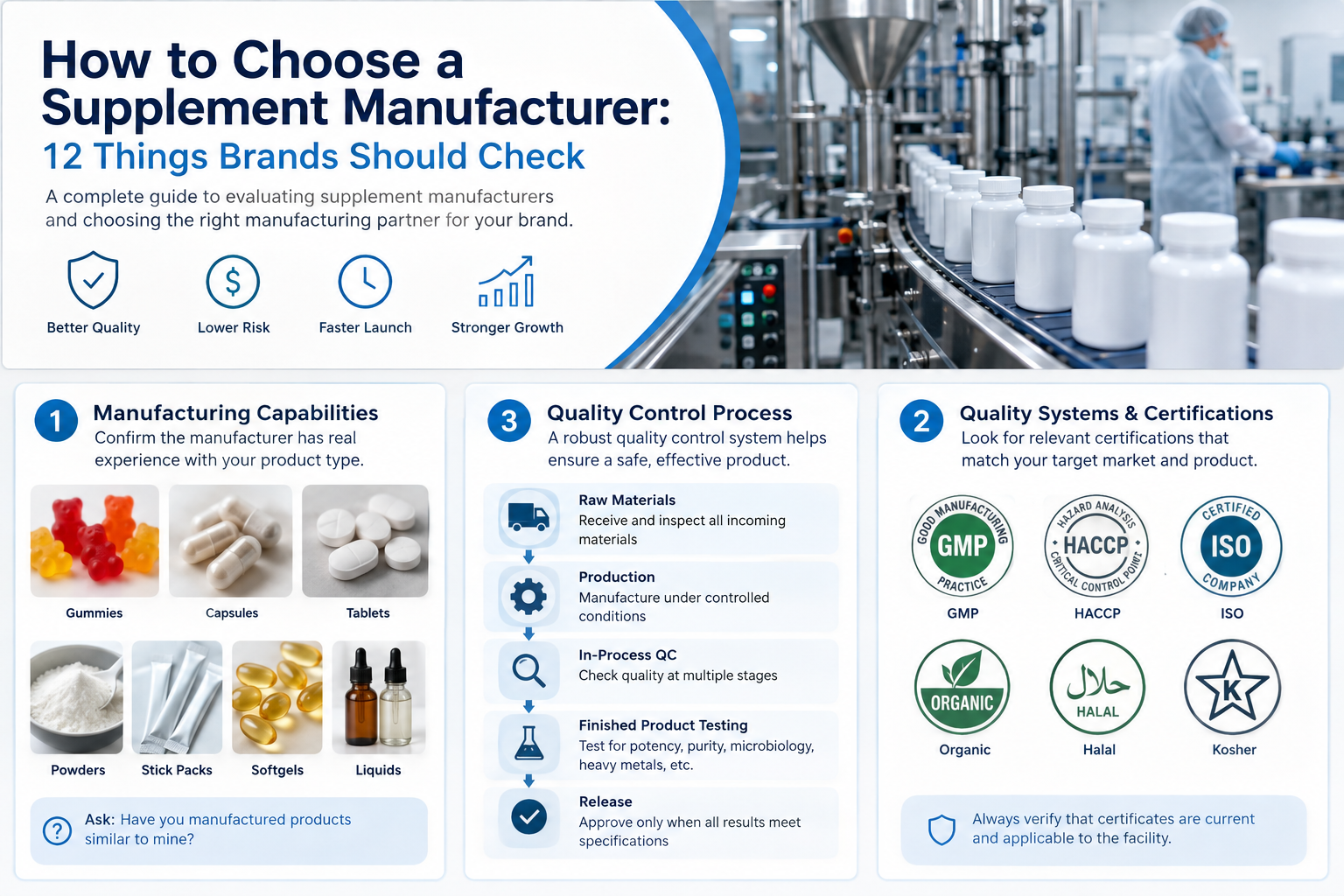
The dosage form affects the customer experience, manufacturing process, packaging, cost, and minimum order quantity. It is one of the first decisions a private label supplement manufacturing partner will help you make.
Common supplement formats include:
Capsules
Capsules are widely used for vitamins, minerals, herbal extracts, probiotics, and functional ingredient formulas.
They are suitable for products that require accurate ingredient dosing and a familiar daily-use format.
Tablets
Tablets can be efficient for high-volume production and may offer flexibility in shape, size, coating, and release characteristics.
Gummies
Gummies provide a more enjoyable consumption experience and are popular in categories such as beauty, sleep, immunity, children’s nutrition, and daily wellness.
Flavor, texture, stability, and active ingredient compatibility need to be considered carefully during development.
Powders
Powders are suitable for sports nutrition, hydration, greens, collagen, protein, and functional drink products.
They can be packed in tubs, pouches, stick packs, or individual sachets.
Softgels
Softgels are commonly used for oils, fat-soluble vitamins, and certain liquid ingredients.
Liquids and Jellies
Liquid and jelly formats can create a convenient and differentiated customer experience, particularly for beauty, energy, wellness, and functional nutrition products.
The right format should be selected based on the formula, target customer, price point, and sales channel—not simply current market trends.
4. Develop and Approve the Product Sample
Sampling is one of the most important stages of product development. In private label supplement manufacturing, the sample is the point where the written specification becomes a physical product you can evaluate.
It allows you to evaluate the product before moving into mass production.
Depending on the dosage form, you may need to review:
- Flavor
- Sweetness
- Aroma
- Color
- Texture
- Capsule size
- Tablet size
- Powder solubility
- Gummy consistency
- Serving experience
- Packaging appearance
A custom product may require several sample rounds.
Feedback should be specific and measurable. For example:
- Reduce sweetness by approximately 15%
- Make the berry flavor less artificial
- Improve powder solubility in cold water
- Use a smaller capsule size
- Increase the firmness of the gummy
Once the sample is approved, the final formula, specifications, packaging materials, artwork, and purchase order should all be confirmed before production begins.
5. Plan Packaging Before Production
Packaging is not simply a design decision. In private label supplement manufacturing, packaging choices also affect your minimum order quantity, freight cost, and shelf presence.
It affects product stability, customer experience, shipping cost, warehousing, fulfillment efficiency, and regulatory compliance. These factors are exactly why private label supplement manufacturing partners review packaging early in the project.
Packaging options may include:
- Bottles
- Jars
- Stand-up pouches
- Sachets
- Stick packs
- Blister packs
- Display boxes
- Subscription kits
Before approving packaging, consider:
- Product quantity per container
- Serving size
- Label dimensions
- Supplement Facts layout
- Barcode placement
- Tamper-evident sealing
- Moisture and light protection
- Shipping weight
- Carton dimensions
- Marketplace requirements
For products intended for the United States, labels may need to include a statement of identity, net quantity, Supplement Facts panel, ingredient list, relevant warnings, and manufacturer, packer, or distributor information.
Marketing claims should also be reviewed carefully. Claims suggesting that a supplement diagnoses, treats, cures, or prevents a disease may create compliance risks.
Packaging and label reviews should be completed before mass printing begins. Correcting an artwork error after production can lead to significant cost and delays.
6. Build Quality Control Into Every Stage
Quality control should begin before production—not after the finished products have already been packed. Strong private label supplement manufacturing partners treat quality control as a continuous process, from raw material intake to final carton sealing.
A structured quality process may include:
Raw Material Review
Raw materials should be reviewed according to the agreed product specifications.
Relevant documents may include:
- Certificates of Analysis
- Ingredient specifications
- Supplier information
- Allergen statements
- Safety documentation
- Traceability records
Pre-Production Confirmation
Before production begins, the team should confirm:
- Final formula
- Approved sample
- Packaging materials
- Label artwork
- Batch quantity
- Production instructions
- Inspection standards
In-Process Quality Control
During production, relevant parameters may be monitored throughout blending, filling, encapsulation, tableting, gummy production, bottling, sealing, and packing.
Finished Product Inspection
Finished products may be checked for:
- Appearance
- Weight
- Product count
- Flavor and texture
- Packaging integrity
- Label accuracy
- Lot coding
- Expiration information
- Carton markings
Laboratory Testing
Depending on the product and destination market, laboratory testing may include identity, potency, microbiological, heavy metal, stability, or other product-specific testing.
Brands should confirm the required testing scope before placing an order.
7. Calculate the True Cost of Your Product
The factory unit price is only one part of the total product cost. In private label supplement manufacturing, the lowest unit price rarely equals the lowest landed cost.
A realistic landed-cost calculation may include:
- Formula development
- Sampling
- Ingredients
- Manufacturing
- Bottles or pouches
- Labels and printed boxes
- Laboratory testing
- Quality inspection
- Freight
- Customs clearance
- Duties and taxes
- Warehousing
- Inventory receiving
- Pick-and-pack fees
- Final-mile delivery
- Returns and replacements
The lowest quotation is not always the most cost-effective solution.
Production delays, packaging errors, poor communication, inconsistent quality, and inventory shortages can cost far more than a small difference in unit price.
The objective should be to build a dependable supply chain—not simply purchase the cheapest product.
Private Label Supplement Manufacturing Costs Explained
Budgets for private label supplement manufacturing vary widely by dosage form, formula, packaging, and order volume. A realistic starting budget for a first production run of a single SKU typically falls between $5,000 and $30,000, depending on the level of customization.
The main cost components in private label supplement manufacturing include:
- Formula development or selection fees
- Sampling and pilot production
- Raw materials and active ingredients
- Manufacturing labor and facility overhead
- Bottles, labels, and printed packaging
- Laboratory testing and certificates of analysis
- Freight, duties, and warehousing
Ask each candidate to itemize these components in writing. Transparent pricing is one of the clearest signals of a dependable private label supplement manufacturing partner.
8. Choose a Fulfillment Strategy
After manufacturing is complete, the product needs to reach your marketplace, retail partner, warehouse, or final customer.
Common fulfillment models include:
Bulk Warehouse Fulfillment
Inventory is transported in bulk to a regional warehouse and shipped domestically to customers.
This is often suitable for brands with stable order volume in a primary market.
Benefits may include:
- Faster customer delivery
- Easier returns
- Predictable fulfillment costs
- Faster marketplace replenishment
Direct-to-Customer Fulfillment
Individual orders are fulfilled directly from the original inventory location.
This model may be useful for brands testing demand, serving multiple regions, or managing smaller sales volumes.
Hybrid Fulfillment
Inventory is divided between different warehouses or fulfillment locations.
For example, part of the inventory may be positioned close to the brand’s main customer market, while reserve stock is held elsewhere for replenishment or international orders.
A hybrid model can provide a balance between delivery speed, inventory flexibility, and cash-flow management.
9. Prepare for Amazon and eCommerce Sales
Each sales channel has different operational requirements. A private label supplement manufacturing partner with fulfillment experience can prepare your product for every channel.
For Amazon FBA, brands may need support with:
- FNSKU labeling
- Carton labels
- Product preparation
- Bundling
- Polybagging
- Case packing
- Shipment planning
- Inventory replenishment
For direct-to-consumer stores, fulfillment operations may include:
- Order synchronization
- Pick and pack
- Branded inserts
- Subscription orders
- Tracking updates
- Return processing
- Inventory reporting
These requirements should be considered during packaging development.
A product designed without fulfillment in mind may result in unnecessary repacking, higher shipping costs, or marketplace delays.
10. Work With One Coordinated Supply Chain Partner
Managing product development, manufacturing, packaging, inspection, transportation, warehousing, and fulfillment through separate companies can create communication gaps.
When a problem occurs, it may be difficult to determine which supplier is responsible.
An end-to-end supply chain partner provides one coordinated point of communication throughout the project. For private label supplement manufacturing, a single coordinator eliminates the gaps that appear when you juggle separate vendors for formulation, production, packaging, and logistics.
At Honson Global, we help supplement and eCommerce brands manage services such as:
- Product and supplier research
- White label and private label manufacturing
- Custom formula development
- Product sampling
- Packaging coordination
- Production monitoring
- Quality inspection
- International transportation
- Warehousing
- Amazon FBA preparation
- Direct-to-consumer fulfillment
- Inventory replenishment
- Return handling
Our goal is to simplify the process between product idea and customer delivery.
Instead of spending your time coordinating multiple service providers, your team can focus on marketing, customer acquisition, and brand growth.
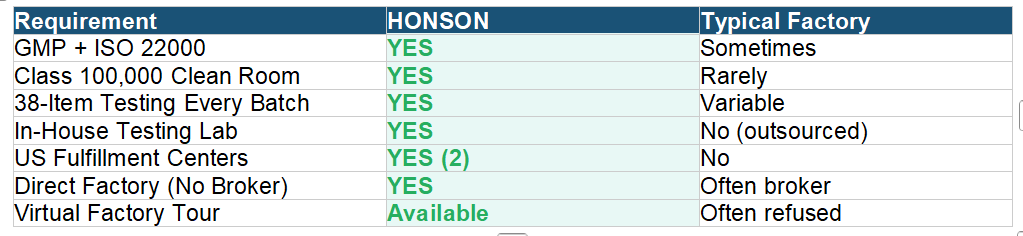
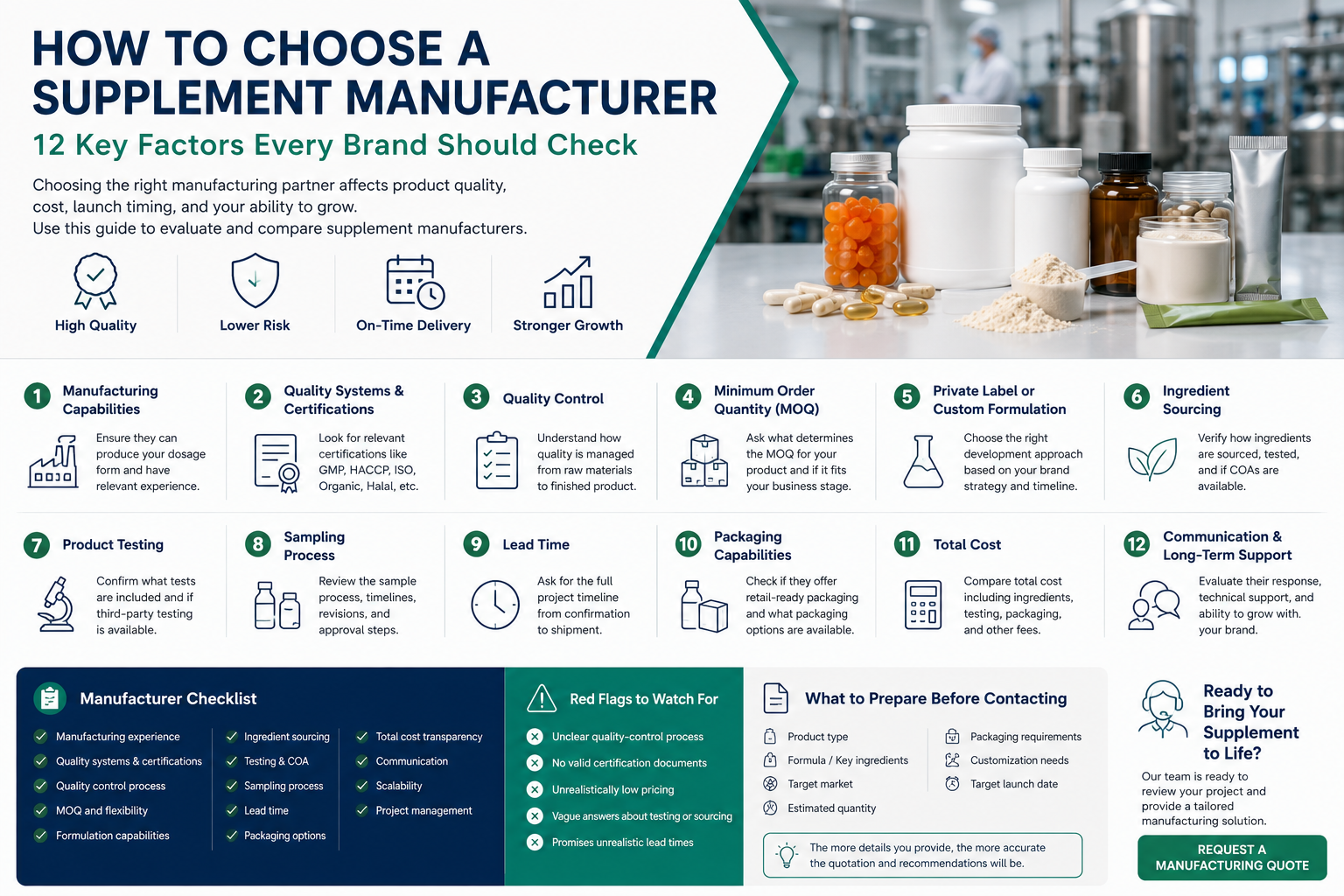
How to Choose a Private Label Supplement Manufacturing Partner
Choosing a private label supplement manufacturing partner deserves the same rigor as choosing a business partner, because the factory becomes part of your brand’s reputation.
- Verify certifications relevant to your destination market
- Ask for references from brands in your category
- Review samples from at least three shortlisted facilities
- Compare minimum order quantities and unit pricing in writing
- Confirm how the partner handles quality issues and returns
- Check communication responsiveness during the quoting phase
A strong private label supplement manufacturing partner will ask you detailed questions about your product, market, and claims. If a supplier only talks about price, that is often a sign of shallow quality systems.
What Should You Include in Your Inquiry?
You do not need to have a completed formula or final packaging design before contacting us.
To receive a more useful initial recommendation, provide as much of the following information as possible:
- Product concept
- Preferred dosage form
- Ingredient list or reference product
- Target customer
- Destination market
- Estimated order quantity
- Packaging requirements
- Target price range
- Required certifications or testing
- Expected launch date
- Delivery destination
- Current sales channel
You can also send:
- A competitor product link
- Product photographs
- An existing label
- A Supplement Facts panel
- Packaging references
- A draft formula
Based on your information, our team can evaluate whether white label, private label, or custom manufacturing is the most appropriate option. Our private label supplement manufacturing experience spans dozens of categories and destination markets.
Frequently Asked Questions
Can you help if I only have a product idea?
Yes. You can begin with a product concept, target audience, reference product, or ingredient list. The development team can help identify suitable manufacturing and packaging options.
Do I need to create a custom formula?
No. Existing white label or private label formulas may be suitable for brands that want to launch more quickly. Custom development is available when stronger product differentiation is required.
What is the minimum order quantity?
Minimum order quantities depend on the dosage form, formula, ingredients, packaging, and level of customization. Existing formulas generally offer more flexibility than fully customized products. In private label supplement manufacturing, MOQ is usually driven by the dosage form and the packaging you choose.
Can you help with packaging?
Yes. Packaging selection, label coordination, printed materials, barcodes, and product presentation can be incorporated into the project.
Can you arrange product testing?
Testing options can be coordinated according to the product specifications and destination-market requirements.
Can you handle warehousing and fulfillment?
Yes. Honson Global supports warehousing, Amazon FBA preparation, inventory management, and direct-to-consumer order fulfillment.
Can you ship products internationally?
Yes. Transportation and delivery solutions can be planned based on the product, order volume, destination, delivery timeline, and sales channel.
How long does private label supplement manufacturing take?
Typical timelines range from 4 to 12 weeks for white label products and 10 to 16 weeks for custom formulations, depending on sampling rounds, packaging lead times, and order volume.
Can private label supplement manufacturing include custom packaging?
Yes. Bottles, labels, cartons, sachets, and display packaging can all be customized. Some private label supplement manufacturing partners also offer in-house design support to speed up the artwork process.
Ready to Launch Your Supplement Product?
A successful supplement product requires more than a formula.
It requires coordinated development, dependable manufacturing, quality control, suitable packaging, efficient logistics, and a fulfillment system that can support future growth.
Honson Global helps brands manage the entire process through one coordinated supply chain team.
Send us your product concept, target market, estimated order quantity, and packaging requirements. We will review your project and recommend a practical next step.
To start, request a quote through our contact page. You can also explore our OEM and ODM dietary supplement services, review how our process works, or read our guide to finding a private label creatine manufacturer for a worked example in a specific category.
For regulatory reference, the U.S. Food and Drug Administration (FDA dietary supplements) and the National Institutes of Health (NIH Office of Dietary Supplements) publish guidance on supplement labeling and ingredient safety.