How Formulation, Packaging and Storage Conditions Affect Supplement Stability Testing and Quality
A supplement formula may look good, the samples may be approved, and the packaging may be ready. But there is still one question brands need to address before launch — and supplement stability testing helps answer it:
How will the product hold up over time?
A powder that flows well during sampling may absorb moisture during storage. Gummies may change in texture. Oils can be sensitive to oxidation. Some ingredients may gradually lose potency under certain storage conditions.
These issues are not always obvious when a product is first manufactured.
For supplement brands, shelf life and supplement stability testing should be considered during product development, not left until the final stage. Understanding what needs to be evaluated can help you make better decisions about ingredients, packaging, testing and launch planning.
What Is Supplement Stability Testing?
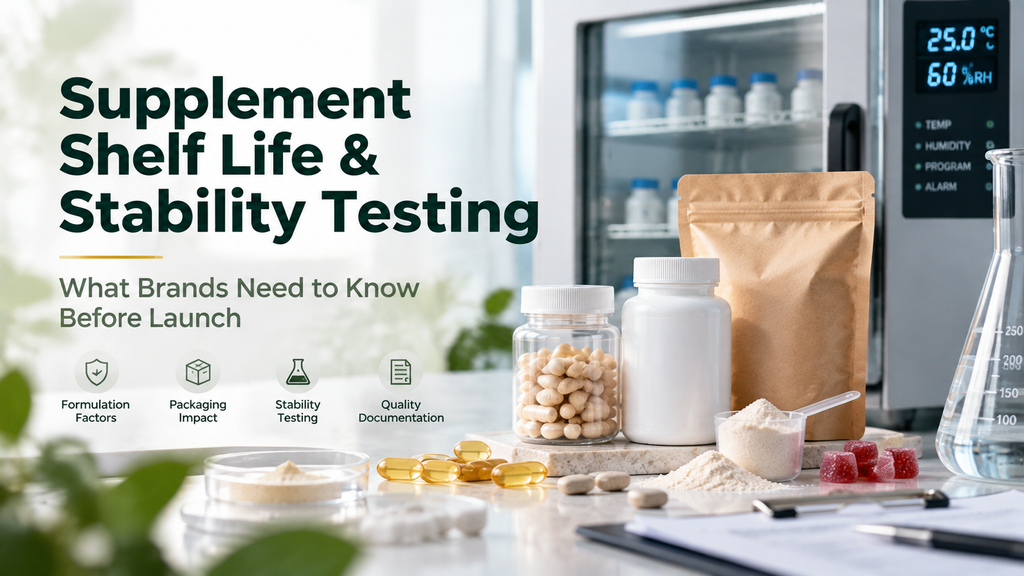
Supplement stability testing evaluates how a product’s quality changes over time under specified storage conditions. The exact approach depends on the formula, dosage form, packaging and intended market.
Depending on the product, relevant quality attributes may include:
- Appearance, color and odor
- Active ingredient levels
- Moisture content or water activity, where relevant
- Microbiological quality
- Physical properties such as texture, flow or disintegration
- Packaging integrity
Not every product needs every test. The testing plan should be based on the characteristics of the actual formula and the quality attributes that matter for that product.
For example, a capsule formula and a powdered drink mix have different potential stability concerns. Using the same generic testing plan for both may not provide the information a brand needs.
Why Does Shelf Life Matter for Supplement Brands?
Shelf life affects more than the date printed on a label. It can influence inventory planning, distribution, retailer requirements and customer confidence.
Before setting a shelf life, brands should understand whether the product can maintain its specified quality throughout the intended storage period. Consider a few common examples:
Powder supplements: Moisture exposure may cause clumping, affect flow properties or change the product’s physical characteristics.
Gummy supplements: Temperature and humidity can affect texture, stickiness and appearance, depending on the formulation.
Oil-based supplements: Oxidation may affect oil quality over time, making appropriate packaging and storage considerations important.
Capsules and tablets: Moisture, heat and other environmental conditions may affect physical properties or ingredient stability.
These are potential concerns, not inevitable outcomes. The actual risks depend on the ingredients, manufacturing process and packaging system.
Real-Time vs. Accelerated Stability Testing
Two approaches commonly discussed during supplement stability testing are real-time and accelerated stability testing.
Real-Time Stability Testing
In real-time studies, products are stored under defined conditions for an extended period and evaluated at planned intervals. This provides direct information about how the product performs under the selected storage conditions.
For brands planning a launch, real-time data can be particularly valuable when evaluating whether a proposed shelf life is supported.
Accelerated Stability Testing
Accelerated studies expose products to elevated temperatures, humidity or other specified conditions to investigate potential changes over a shorter period. These studies can help identify possible stability concerns and inform development decisions.
However, accelerated testing should not automatically be treated as proof of a specific shelf life. The relationship between accelerated results and long-term product performance depends on the product and the scientific basis of the study.
A suitable supplement stability testing program may use one or both approaches, depending on the formula, available data, intended shelf life and applicable market expectations.
How Packaging Affects Supplement Stability
Packaging is part of the product’s protection system. It should be selected with the formula in mind, rather than based on appearance alone. Four factors deserve particular attention.
1. Moisture
Some powders and other moisture-sensitive products require packaging with suitable moisture-barrier properties. The appropriate material depends on the product’s characteristics and storage conditions.
2. Oxygen
Certain ingredients, including some oils, may be sensitive to oxygen exposure. The packaging structure and closure system may therefore be important considerations.
3. Light
Some ingredients can be affected by light. Depending on the formula, an opaque container, protective packaging or another suitable solution may be worth evaluating.
4. Temperature
Packaging cannot eliminate every risk associated with temperature. Products should be evaluated under appropriate storage conditions, and any special storage instructions should be based on the product’s requirements.
This is why packaging decisions should begin during formulation and sampling. If the formula and container are considered separately, brands may discover compatibility or protection issues later in the project. For packaging options, see Honson Global’s supplement packaging services.
What Should Brands Confirm Before Starting Stability Testing?
Before commissioning or arranging a supplement stability testing study, it helps to clarify the following points with your manufacturing partner.
Product specifications: Which quality attributes need to remain within the agreed limits throughout the proposed shelf life?
Testing plan: Which tests are appropriate for the formula, and at what intervals will samples be evaluated?
Storage conditions: What temperature, humidity or other conditions will be used, and how do they relate to the product’s intended storage and distribution?
Commercial packaging: Will the product be evaluated in the packaging intended for sale? Packaging can affect exposure to moisture, oxygen and light.
Documentation: What reports, test results and product specifications will be available to support the project?
Target market: Where will the product be sold? Requirements and expectations may differ by market, so this should be established early.
These questions are more useful than asking only whether a manufacturer “offers stability testing.” They help clarify what the testing is intended to demonstrate and whether the available documentation fits the project’s needs.
Stability Testing, COA and Finished Product Testing: What’s the Difference?
These terms are related, but they do not mean the same thing. A Certificate of Analysis (COA) reports analytical results or other specified information for a particular material or batch. Finished product testing evaluates selected product attributes against established specifications.
Supplement stability testing looks at how selected quality attributes change over time under defined conditions. A product may meet its specifications when initially tested, but that result alone does not establish how it will perform throughout a proposed shelf life.
Brands should therefore understand what each document covers rather than treating a single COA as a substitute for stability data. For more information, read our guide to supplement COAs and third-party testing.
When Should Stability Planning Begin?
The best time to discuss supplement stability testing is during product development. Waiting until the formula, packaging and launch date have all been finalized can create avoidable pressure.
A more practical sequence is:
- Define the product and its target market.
- Identify the formula’s potential stability concerns.
- Select suitable packaging for evaluation.
- Agree on relevant specifications and testing requirements.
- Plan testing and documentation alongside production and launch preparation.
Stability studies can take time, and the appropriate duration depends on the study design and product. They should be incorporated into the project plan rather than treated as an afterthought.
If you are working toward a specific launch date, also consider how testing and documentation fit into your overall production schedule. Our supplement manufacturing timeline guide explains other factors that can affect project timing.
How Honson Global Supports Supplement Development
At Honson Global, product development involves more than choosing ingredients and arranging production. Formula requirements, dosage form, packaging and quality considerations all need to be reviewed as part of the project.
We support brands developing different supplement formats, including gummies, capsules, tablets, softgels, powders and liquids.
For a new project, brands can share their product concept, target market, preferred dosage form, packaging requirements and estimated order quantity. This gives the team a clearer starting point for discussing manufacturing requirements and the quality documentation that may be relevant.
Testing needs and available documentation depend on the product and project specifications, so these details should be confirmed before the project begins.
Planning a New Supplement Product?
If you are developing a supplement and need to plan for shelf life, packaging and quality documentation, it is worth discussing these requirements before production starts.
Share your product concept, dosage form, target market and packaging plans with Honson Global. Our team can help you review the manufacturing considerations for your project and identify the next steps.
Frequently Asked Questions
Does every dietary supplement need an expiration date?
In the United States, FDA’s dietary supplement CGMP guidance does not require every dietary supplement to carry an expiration date. However, if a manufacturer places an expiration or similar date on a product, it should have data supporting that date. Requirements in other markets may differ.
How long does supplement stability testing take?
There is no single timeline for every product. The duration depends on the study design, storage conditions, testing intervals, product characteristics and proposed shelf life.
Is accelerated stability testing enough to establish shelf life?
Not automatically. Accelerated studies can provide useful information, but whether the results support a proposed shelf life depends on the product and the scientific justification. Real-time supplement stability testing data may also be needed.
Is a COA the same as a stability report?
No. A COA reports specified analytical results for a material or batch. A stability report evaluates selected quality attributes over time under defined conditions — this is the purpose of supplement stability testing.
Can packaging affect supplement shelf life?
Yes. Depending on the formula, packaging materials and closures can influence exposure to moisture, oxygen and light. The packaging should be evaluated against the product’s actual requirements.