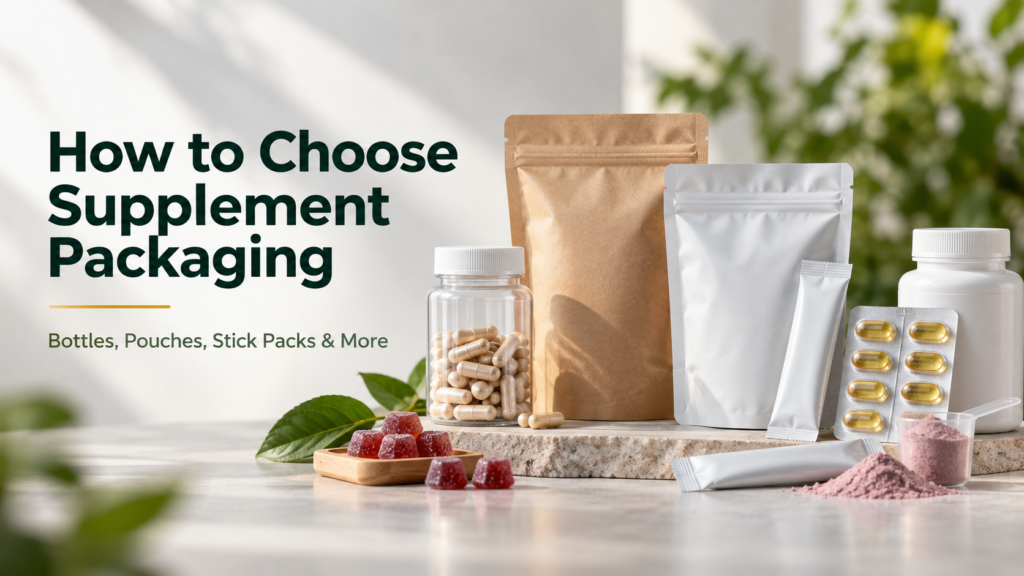
A Practical Supplement Packaging Guide for Brands Before Production
A supplement formula can be ready for production, but the wrong supplement packaging decision can still increase costs, delay a launch, or create unnecessary problems later.
For a new supplement brand, packaging often starts with a simple question:
Should we use a bottle, pouch, stick pack, or blister pack?
The answer depends on more than appearance. The right packaging should match the product format, serving count, sales channel, storage requirements, shipping strategy, and target market.
A bottle may work perfectly for capsules but add unnecessary shipping volume for a powder product. A stick pack may offer excellent convenience, but it can require a very different filling and packaging setup than a standard pouch.
That is why packaging should be considered early — not after the formula is already finished. This supplement packaging guide explains the main supplement packaging options and what brands should consider before production begins.
Start With the Supplement Format
The product itself should usually come before the packaging style. Different dosage forms have different filling, protection, and storage requirements. If you are still deciding between capsules, gummies, powders, and other forms, see our guide on how to choose the right supplement format.
| Supplement Format | Common Packaging Options |
|---|---|
| Gummies | Bottles, pouches, blister packs |
| Capsules | Bottles, blister packs, sachets |
| Tablets | Bottles, blister packs |
| Softgels | Bottles, blister packs |
| Powders | Jars, pouches, stick packs, sachets |
| Liquids | Bottles, dropper bottles, single-dose formats |
For example, a 60-count capsule product may fit naturally into a standard supplement bottle. A collagen powder may make more sense in a large jar or stand-up pouch. A hydration powder designed for travel may be better suited to single-serving stick packs. The packaging should support how the customer will actually use the product.
Bottles: Familiar, Flexible and Easy to Understand
Bottles remain one of the most common supplement packaging choices in the industry. They work especially well for:
- Capsules
- Tablets
- Gummies
- Softgels
One major advantage is familiarity. Consumers already understand how to use a supplement bottle, and brands have many options for size, shape, cap style, labeling, and material.
Advantages of Supplement Bottles
- A familiar retail format
- Large label areas
- Multiple size options
- Straightforward counting and filling
- Compatibility with different closures and seals
They are also useful when brands want a traditional supplement appearance.
What Brands Should Consider
A larger bottle does not automatically mean a better presentation. As this supplement packaging guide notes, bottle size should match:
- Serving count
- Product volume
- Capsule or gummy size
- Label dimensions
- Shipping requirements
A bottle with too much empty space can make the product feel poorly planned, while a container that is too small can create filling and handling problems. Brands should also consider seals, liners, caps, and moisture-management solutions where appropriate.
Stand-Up Pouches: Lightweight and Flexible
Stand-up pouches have become increasingly common in supplement packaging, especially powders and gummies. They can be a strong option for brands selling online because they are lightweight and take up less space than many rigid containers.
Common applications include:
- Protein and functional powders
- Collagen powders
- Gummies
- Larger-count products
- Refill products
Advantages of Pouches
- Lower packaging weight
- Reduced storage space
- Large printable branding areas
- Resealable closures
- Flexible sizing
They can also create a more modern look for direct-to-consumer brands.
What Brands Should Consider
Not all pouches provide the same level of product protection. The material structure should be selected based on the product. A powder sensitive to moisture may require a different barrier structure than a standard dry product. Brands should therefore consider both appearance and packaging performance.
Stick Packs: Designed for Convenience
Stick packs are especially useful for single-serving supplement packaging. They are commonly used for:
- Electrolyte powders
- Collagen
- Creatine
- Greens
- Functional drink mixes
- Other powdered supplements
For customers, the appeal is simple:
open one stick, mix it, and go.
That convenience can make stick packs attractive for travel, gym use, sampling, and premium product positioning.
Advantages of Stick Packs
- Precise single-serving portions
- Easy portability
- Convenient daily use
- Strong retail presentation
- Opportunities for multi-flavor packs
However, stick packs are not simply “small pouches.” Brands also need to consider:
- Filling requirements
- Film structure
- Unit packaging cost
- Carton configuration
- Secondary packaging
- Production setup
For some products, the customer experience may justify the additional complexity. For others, a standard pouch may be more cost-efficient.
Blister Packs: When Individual Protection Matters
Blister packaging is another option this supplement packaging guide covers, especially for:
- Capsules
- Tablets
- Softgels
Each unit is separated into its own cavity, which can provide a very different customer experience from a traditional bottle. Potential advantages include:
- Individual product protection
- Easy portability
- Clear serving organization
- Premium or pharmaceutical-style presentation
Blister packs may be useful when a brand values individual unit presentation or additional separation between doses. However, they can also involve different tooling, materials, and production requirements compared with standard bottle filling. That should be considered early in the project.
Packaging Should Protect the Product, Not Just Sell It
A package can look excellent on a shelf and still be the wrong choice for the formula inside. As this supplement packaging guide explains, supplement products may be affected by:
- Moisture
- Oxygen
- Light
- Heat
- Storage conditions
That means supplement packaging material selection should be part of the product-development discussion. For example, certain sensitive formulas may need stronger moisture or oxygen barriers, while other products may benefit from containers that reduce light exposure. For supplements sold in the United States, the packaging, labeling, and manufacturing process must also comply with the FDA CGMP requirements for dietary supplements (21 CFR Part 111).
The exact solution depends on the formula and its requirements. This is one reason brands should avoid selecting packaging based only on a photo or competitor product — a similar-looking container may not provide the same material properties.
Packaging Cost Is More Than the Price of the Container
A common mistake is comparing packaging like this:
Bottle A costs less than Pouch B.
That only tells part of the story. The real supplement packaging cost may include:
- Container
- Cap or closure
- Label
- Printing
- Filling
- Carton
- Secondary packaging
- Freight
- Storage
- Fulfillment
A slightly more expensive container may reduce shipping volume. A lightweight pouch may lower freight but require a different filling process. Stick packs may increase unit packaging cost but create a stronger convenience proposition for the customer.
So the better question is:
What does this packaging option cost across the entire product journey?
Not simply:
How much does the empty container cost?
Think About Your Sales Channel
Packaging should also match where the product will be sold.
E-Commerce
Online brands may care more about:
- Shipping weight
- Package dimensions
- Damage resistance
- Fulfillment efficiency
Retail
Retail products may place more emphasis on:
- Shelf presence
- Label visibility
- Display format
- Barcode and carton requirements
Travel or On-the-Go Products
Convenience formats such as stick packs or sachets may make more sense when portability is part of the product concept. The same formula can be packaged very differently depending on the sales channel.
Serving Count Should Be Decided Before Final Packaging
Supplement packaging and serving count are closely connected. A brand offering 30 servings, 60 servings, or 90 servings may need very different container sizes. If you are unsure how many servings to offer, our supplement serving count guide walks through the trade-offs.
This affects more than appearance. It can influence:
- Packaging cost
- Shipping weight
- Product dimensions
- Retail price
- Customer perception
Brands should therefore decide serving count and packaging together rather than treating them as separate decisions. If your serving count is still uncertain, that should be resolved before artwork is finalized.
When Should Supplement Packaging Be Confirmed?
Ideally, packaging discussions should begin while the formula is still being developed or sampled. Do not wait until full production is ready. Packaging is one of the most common hidden timeline risks — see our supplement manufacturing timeline guide to understand how late packaging decisions can delay a launch.
A practical sequence is:
Formula direction → serving count → packaging format → sample approval → final artwork → production
This does not mean every packaging detail must be finalized on day one, but the main direction should be clear early. For example:
- Bottle or pouch?
- Individual serving or multi-serving?
- Retail or e-commerce?
- 30 servings or 60 servings?
These decisions can affect both production planning and the final launch timeline. Packaging is one of the reasons a product can be technically ready but still not ready to manufacture.
Custom Packaging vs Standard Packaging
Not every brand needs completely custom supplement packaging from the first production run — this supplement packaging guide explains when each approach makes sense.
Standard packaging may be more practical when:
- Launch speed matters
- The brand is testing a new product
- Order quantities are smaller
- Existing packaging already fits the product
More customized packaging may make sense when:
- Shelf differentiation is important
- Packaging is central to the brand identity
- Larger production volumes justify customization
- The product requires a specific format
The best packaging strategy should fit the stage of the business. A startup launching its first SKU may have different priorities from an established brand expanding into major retail.
How Honson Global Supports Your Supplement Packaging Guide
At Honson Global, packaging can be coordinated as part of the overall supplement development and manufacturing process. Depending on the project, brands can discuss options including:
- Bottles and closures
- Stand-up pouches
- Stick packs
- Sachets
- Blister packs
- Label and artwork coordination
- Packaging material selection
- Finished product packing
Because packaging is connected with formula format, serving count, production, shipping, and fulfillment, it is useful to discuss these decisions as part of one project rather than as a separate final step. Learn more on our supplement packaging services page, where our team can review the product concept and help identify packaging options that better match the brand’s market and manufacturing requirements.
Not Sure Which Packaging Fits Your Supplement?
You do not need to select packaging before speaking with a manufacturer. Use this supplement packaging guide as a starting point, then send us:
- Your supplement format
- Formula or product concept
- Serving count
- Target market
- Estimated order quantity
- Preferred sales channel
Our team can review the project and discuss suitable packaging directions before production begins.
Final Thoughts
This supplement packaging guide makes one thing clear: choosing packaging is not only a branding decision. The right format should balance:
- Product protection
- Customer convenience
- Manufacturing requirements
- Cost
- Shipping
- Brand positioning
Bottles may be ideal for one product, while pouches or stick packs may make far more sense for another. The important thing is to make the decision early enough that packaging supports the product instead of delaying it.
A good manufacturing partner should help you evaluate the full picture — not simply hand you a packaging catalog.
Frequently Asked Questions
What is the best packaging for supplements?
There is no single best option. The right supplement packaging depends on the dosage form, serving count, product stability, target market, sales channel, and budget — this supplement packaging guide covers the main trade-offs.
Are pouches better than bottles for supplements?
Not always. Pouches can reduce weight and storage space, while bottles provide a familiar format and work well for capsules, tablets, gummies, and softgels. The best choice depends on the product.
What supplements are suitable for stick packs?
Stick packs are commonly used for single-serving powdered products such as electrolytes, collagen, creatine, greens, and functional drink mixes.
When should packaging be selected?
Packaging direction should ideally be discussed during formula development and sampling, rather than waiting until the product is completely ready for production.
Can supplement packaging be customized?
Yes. Packaging may be customized through container selection, labels, printing, materials, colors, secondary cartons, and other branding elements, depending on project requirements and order quantity. For a complete overview, review this supplement packaging guide.