Introduction
Quality documentation and independent testing have become non-negotiable requirements for supplement brands selling into the United States. Marketplaces such as Amazon apply strict document checks via its TIC (Testing, Inspection and Certification) third-party verification workflow, while FDA cGMP regulations place full product-quality accountability on brand owners, not solely on contract manufacturers. Understanding how a supplement COA works is essential before choosing a manufacturing partner. For US-market launches, products must also comply with FDA requirements for dietary supplements.
Many first-time supplement brand owners hold misunderstandings around Certificates of Analysis (COAs) and third-party testing. Common misconceptions include trusting generic batch-unspecific documents, confusing in-house lab results with accredited third-party reports, or underestimating testing-related costs and timelines. Insufficient or invalid testing documentation may lead to Amazon listing removals, FDA import detentions, retail-partner rejections, and costly post-production revisions. Amazon US no longer permits sellers to manually upload raw COA files directly; valid reports must go through approved TIC providers such as Eurofins, UL or NSF for formal validation, even if your original lab report is ISO/IEC 17025-accredited.
This practical B2B guide explains core concepts of COAs and third-party testing, key testing panels, accreditation standards, Amazon-specific marketplace compliance rules, common pitfalls, and manufacturing-partner evaluation criteria. This resource will help private-label and custom-formulation supplement brands build robust quality workflows and lower regulatory risk during product launch and scaling.

What Is a Supplement COA (Certificate of Analysis)?
A Certificate of Analysis (COA) is a formal laboratory document recording measurable test results for a specific production batch. It captures identity, potency, purity, contaminant screening and other analytical data against pre-defined product specifications. For Amazon US submission purposes, valid COAs must list full product name, unique batch/lot number, issuing-lab full name & address, quantitative assay data, and clear references to test methodologies; simple “pass / conform” summary statements alone are not accepted by platform auditors.
There are two primary COA categories supplement brands will encounter:
In-house COA Generated by the manufacturing facility’s internal laboratory. In-house testing supports internal quality-control workflows at the factory. For US-market sales, in-house documents alone often cannot satisfy marketplace or third-party retail compliance demands. Amazon-approved TIC providers may accept in-house generated reports only after secondary independent validation, and will not treat factory-internal COAs as standalone compliant deliverables.
Third-party-lab COA Produced by an independent external laboratory with no direct commercial interest in the production run. For most high-risk scenarios including Amazon listing validation, import review and large retail-partner onboarding, an ISO/IEC 17025-accredited third-party COA is preferred or required. Well-recognized global TIC organizations active within dietary-supplement compliance include Eurofins, NSF and UL Solutions, all authorized within Amazon’s third-party verification framework.
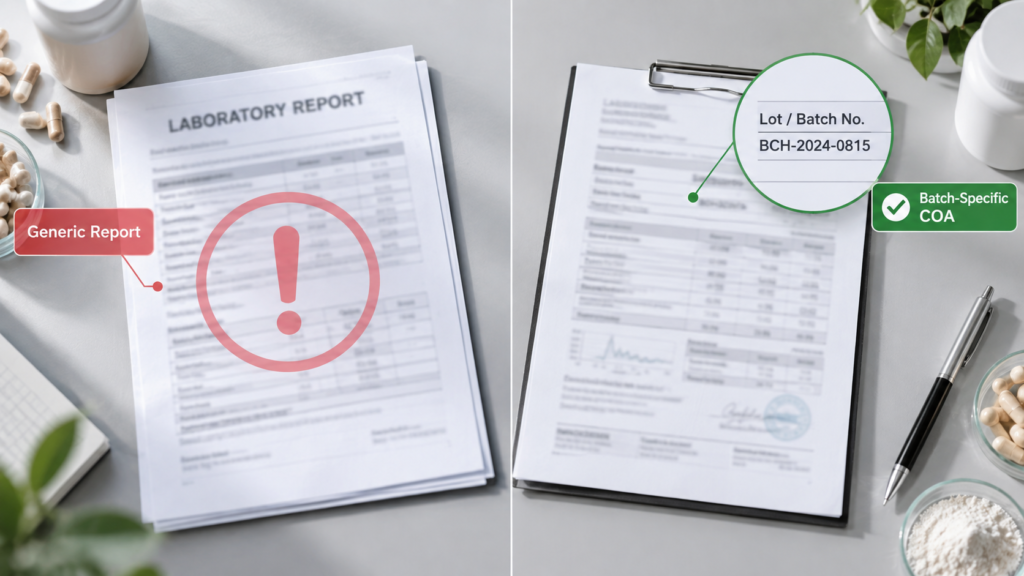
Critical note: A valid usable COA must reference your exact finished-goods batch number. Generic, batch-free COAs pulled from stock-formula libraries cannot prove quality for your specific manufactured lot. Amazon explicitly rejects batch-unspecific generic COA submissions during ASIN compliance audits.
Core Testing Panels for Finished Dietary-Supplement Batches
Different product categories require adjusted testing scopes. The following test suites represent baseline expectations for supplement finished goods intended for US distribution, aligned with USP specifications and Amazon marketplace audit criteria for dietary-supplement ASINs.
Identity Testing Confirms raw-material ingredients match label declarations. Analytical methods such as HPLC or spectroscopy verify ingredient authenticity, helping mitigate risks of ingredient substitution or adulteration.
Potency / Assay Testing Measures active-ingredient content per serving. This verifies whether finished-product potency aligns with label dosage claims. Deviations may emerge from raw-material variation, manufacturing blending processes or stability degradation over shelf-life. Amazon compliance rules require quantitative potency assay results mapped one-to-one against every active ingredient shown on the Supplement Facts panel of product labels.
Contaminant Screening
- Heavy-metal testing: Evaluates lead, arsenic, cadmium and mercury following USP-defined specifications. Especially critical for botanical-derived raw-material products.
- Microbiological testing: Checks aerobic bacteria, yeast, mold and indicator pathogens to confirm microbial safety of finished goods.
- Pesticide & mycotoxin screening: Mostly applied to herbal and plant-source supplement raw materials. High-risk Amazon supplement categories (weight-management, sports-nutrition, joint-support, sexual-enhancement formulations) mandate expanded contaminant-panel screening as a platform policy requirement.
Additional Targeted Testing Sports-nutrition products may require banned-substance screening for competitive-athlete channels. Allergen verification becomes essential when production lines handle common allergen raw materials.

Third-Party-Laboratory Accreditation Standards Brands Must Understand
Not every independent laboratory document qualifies for US-market compliance purposes. ISO/IEC 17025 accreditation represents the globally-recognized baseline for analytical laboratories performing supplement testing.
Brands need to examine not merely whether a lab holds ISO 17025 certification overall, but the scope of accreditation. A laboratory can hold general ISO 17025 accreditation without being accredited for dietary-supplement-matrix testing. Reports from labs lacking supplement-relevant accreditation scope will get rejected by Amazon and retail auditors, even if the lab owns general ISO/IEC 17025 credentials. Amazon-authorized TIC partners such as Eurofins maintain clearly-defined accreditation scopes covering dietary-supplement test matrices for this exact reason.
Key questions to ask your manufacturing partner or selected lab:
- Is the laboratory ISO/IEC 17025-accredited specifically for dietary-supplement matrices?
- Can testing reports be generated tied to individual finished-goods batch numbers?
- What is typical turnaround time for requested test panels?
- Are complete test-method references included within final COA documentation?
How Supplement COA and Third-Party Testing Requirements Differ by Brand Scenario
Private-label stock-formula projects (see our supplement manufacturer guide)
Stock-formula products can leverage existing validated test datasets, yet brands still require batch-specific finished-goods COAs for each production run. Pre-existing historical third-party reports for a stock formula do not replace batch-level testing for your own manufactured inventory. Even proven stock formulas need fresh batch-linked documentation for Amazon TIC review processes.
Fully-custom-formulation projects
Custom formulations require full-scope third-party testing for initial pilot and stability batches. New ingredient combinations may introduce unanticipated stability or interaction risks, making independent analytical validation especially important. Custom-formulation batches must also produce batch-specific COAs to satisfy marketplace and import-compliance workflows.
Different sales-channel requirements
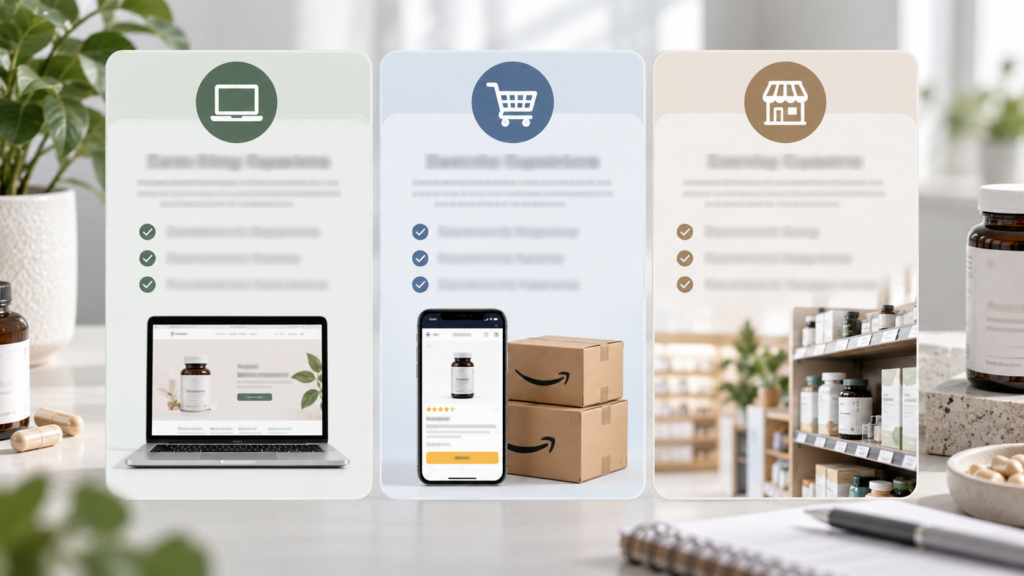
Direct-to-consumer independent-website sales: Must still satisfy FDA cGMP record-keeping obligations, retaining batch-specific COAs for every lot under 21 CFR Part 111 record-retention rules.
Amazon US marketplace: Requires third-party ISO 17025-validated documentation for many supplement categories; incomplete documentation triggers listing suppression or removal. Important procedural update: sellers cannot directly upload COA documents to Amazon backend; reports must be reviewed and submitted by one of Amazon-approved TIC service providers (Eurofins, UL, NSF). Existing ISO 17025 lab reports may be forwarded to TIC partners for secondary validation to avoid redundant retesting, but annual re-verification per ASIN remains mandatory under current platform policy
Brick-and-mortar retail distributors: Retail buyers frequently conduct pre-onboarding document audits and demand access to third-party test records prior to accepting your product line. Many large US retail chains adopt document-review standards closely aligned with Amazon’s TIC-style validation logic.
Common Supplement COA & Third-Party Testing Mistakes Brands Should Avoid
Accepting generic non-batch-specific COAs
One widespread error is accepting generic documents without matching lot numbers. Generic COAs describe historical reference batches and cannot prove quality for your ordered finished goods. Always cross-reference COA lot numbers against physical production batch records. Amazon TIC auditors consistently reject generic lot-unspecific COA submissions.
Treating factory in-house COAs as full marketplace-ready compliance documents
Factory internal lab results serve factory quality-control purposes. Major US sales channels usually require independent third-party evidence beyond internal QC paperwork. Even high-quality in-house COAs will normally need secondary validation via an accredited TIC lab for Amazon ASIN clearance.
Ignoring additional testing lead-time within overall project timelines
Many brand owners only budget production time and overlook laboratory turnaround. Third-party testing frequently adds multiple weeks to overall project timelines. Delays in receiving completed COA can block product listing activation or import-clearance workflows. Adding the Amazon TIC provider’s validation review cycle further extends total compliance-processing lead-times and should be built into brand launch schedules.
Assuming accreditation certificates automatically equal valid supplement-oriented reports
ISO 17025 is a broad accreditation standard. Verify the lab’s accredited testing scope explicitly covers supplement matrices before committing orders. General-scope ISO-accreditation without supplement-matrix coverage results in reports rejected by Amazon and retail-channel auditors.
Misunderstanding regulatory boundaries: third-party testing is not equivalent to FDA product approval
Dietary supplements do not receive pre-market FDA approval. Third-party testing validates batch-level product quality; it does not grant regulatory approval for your finished supplement product. Brands remain fully accountable for label language and marketing claims. It is critical to note that Amazon-TIC / Eurofins / NSF validation only verifies lab-report compliance and does not constitute FDA product-approval status either.
How Honson Global Supports Brands With COA Documentation & Testing Workflows
Honson Global helps supplement brand partners navigate complex US-market testing-documentation expectations for private-label, semi-custom and fully-custom supplement projects across all dosage forms, including workflows designed to align with Amazon TIC-provider validation requirements such as Eurofins, UL and NSF.
Our team supports brands across three core collaborative phases:-
Product-line Direction Early-stage consultation to outline required testing scopes aligned with your target sales channels, category risks and project budget. Clarify expectations for in-house QC versus third-party-lab deliverables before production commences, including pre-assessment of documentation format to reduce rejection risks during Amazon TIC review.
Manufacturing & Quality-Documentation Strategy Coordinate raw-material incoming verification, in-process factory quality control, finished-batch sampling, and documentation organization. We work with accredited external laboratory resources to generate batch-tied COA documents matching US-market documentation standards and meeting baseline formatting expectations of Amazon-approved TIC organizations.
Post-production Compliance Support Deliver organized, batch-linked quality documentation packages. Guide brands on proper COA file storage practices to satisfy FDA record-retention requirements and marketplace-audit readiness, including best practices for preparing files for onward submission to TIC verification partners.
Regulatory note for US-market projects: Under FDA 21 CFR Part 111 cGMP rules, brand owners retain ultimate responsibility for finished-product quality and record-keeping, regardless of which manufacturing partner you select, even when third-party labs or Amazon-authorized TIC firms perform document validation work.
Frequently Asked Questions
Q1: Do I need third-party ISO 17025 testing for every single supplement production batch?
Channel requirements vary. Amazon and many retail partners demand third-party-lab-generated documentation for each lot. Even when third-party reports are not marketplace-mandated, cGMP rules still require complete identity-and-potency-related testing records to be maintained for every batch. Note: Amazon TIC annual-verification is per-ASIN compliance requirement and operates separately from per-batch finished-goods testing records.
Q2: Can I reuse one third-party COA across multiple separate production batches?
No. Valid third-party COAs are tied to one unique finished-goods batch number. Each new manufacturing run requires corresponding sampling and reporting. Re-using single-batch COAs for multiple production lots counts as non-compliant practice for Amazon audits.
Q3: What extra costs should I plan for third-party supplement testing?
Costs vary by test-panel scope, laboratory selection and sample quantity. Brands should budget for laboratory-sampling logistics, analytical fees, and allow extra lead-time within overall project planning. Testing-related expenses represent a normal component of US-market supplement-brand operating costs. When selling on Amazon US, you should also budget potential TIC-provider validation administrative fees (Eurofins / UL / NSF service charges) even when you already hold valid ISO 17025 lab-reports.
Q4: If my manufacturer provides a COA, does that remove my brand’s regulatory responsibility?
No. Even when your contract manufacturer supplies complete test documentation, legal and compliance accountability still sits with the supplement brand owner selling products within US territory. Brands should conduct independent document reviews. Amazon-TIC third-party validation does not transfer away brand-owner regulatory accountability either.
Q5: What happens if third-party test results fall outside pre-set specifications?
Out-of-spec results trigger formal non-conformance handling workflows. Possible steps include formula reassessment, raw-material-source review, production-process adjustment and batch quarantine. This reinforces why testing should be completed prior to full-scale market distribution. If out-of-spec results emerge during Amazon-TIC validation, the corresponding ASIN will face immediate listing-restriction risk.
Q6: If I already hold ISO 17025 lab reports from another lab, can I submit directly to Amazon?
No. Amazon US marketplace no longer accepts direct seller-upload of COA files. Existing ISO 17025-accredited lab-reports must be sent to one of Amazon-authorized TIC service partners (Eurofins, UL, NSF). The TIC provider will perform secondary document validation; depending on findings they may accept existing reports or mandate partial / full retesting before ASIN compliance clearance is granted.
Final Thoughts
COA documentation and third-party testing are not merely extra administrative hurdles for supplement brands entering the US market. They represent foundational quality-assurance tools that protect your brand against listing suspension, import detention, retail-partner rejection and reputational risk. New Amazon-marketplace procedural changes centered around TIC third-party verification (with authorized providers such as Eurofins, UL and NSF) add an additional critical compliance layer that modern private-label supplement brands must plan for alongside FDA cGMP 21 CFR Part 111 obligations.
Understand the difference between in-house QC reports and accredited third-party-lab deliverables, always validate batch-number alignment, match testing panels to your sales-channel requirements, and build both lab-testing turnaround plus TIC-validation review-time into your overall project roadmap. Investing in proper testing workflows early creates more stable, predictable brand growth.