When developing a new supplement, brands often spend a great deal of time discussing the formula.
How many milligrams should each serving contain?
Which ingredients should be used?
Should the product be a capsule, gummy, powder, tablet, or softgel?
But one seemingly simple question is often left until much later:
How many servings should be in each bottle?
30 servings?
60 servings?
90 servings?
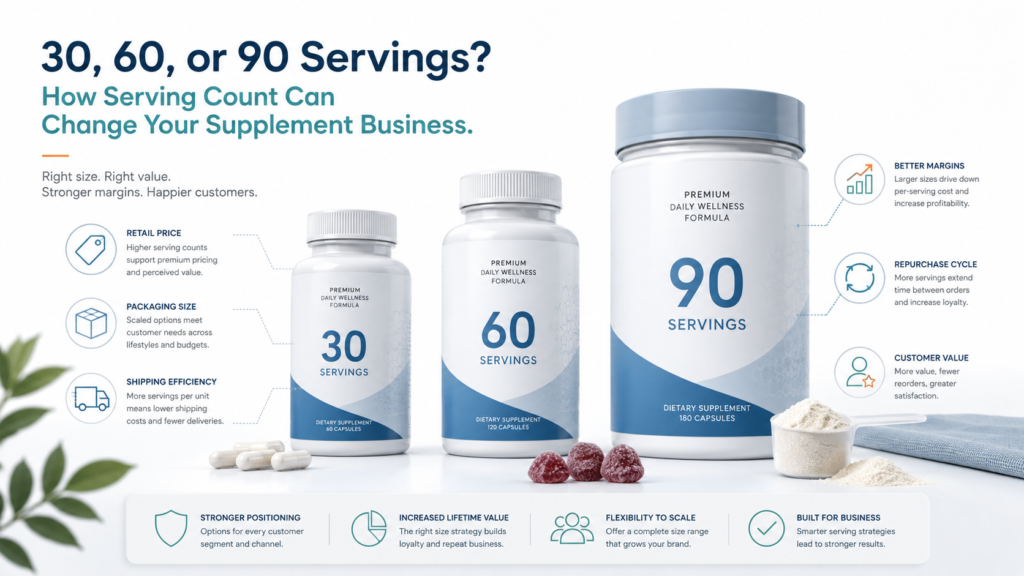
At first, serving count may look like nothing more than a number on the Supplement Facts panel.
In reality, it can influence your product’s:
- Retail price
- Cost per serving
- Packaging size
- Shipping cost
- First-purchase barrier
- Repurchase cycle
- Subscription strategy
- Perceived value
- Overall market positioning
That is why serving count should not be treated as a packaging decision made at the end of product development.
It should be part of the product’s business model from the beginning.
The Same Formula Can Become Two Very Different Products
Imagine two brands developing nearly identical magnesium supplements.
The formulas are similar.
The ingredient quality is similar.
The daily dosage is similar.
Brand A chooses:
30 servings per bottle
Brand B chooses:
60 servings per bottle
From a formulation standpoint, the difference may appear simple: one bottle contains twice as much product.
From the consumer’s perspective, however, these can feel like two completely different offers.
A 30-serving bottle may allow the brand to keep the retail price lower, making it easier for a new customer to try the product.
A 60-serving bottle may create a stronger value proposition:
“One bottle lasts approximately two months.”
At that point, the brand is no longer making only a packaging decision.
It is deciding:
How much should the customer pay the first time, and when should that customer need to buy again?
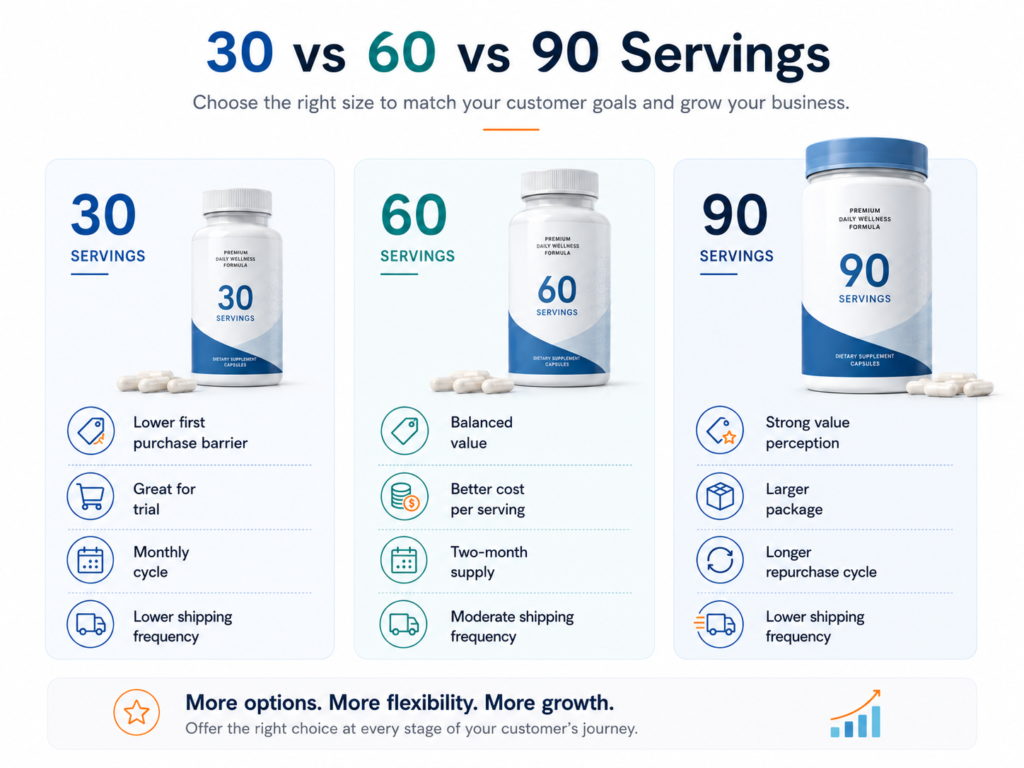
1. 30 Servings: Lowering the Barrier to the First Purchase
Thirty servings is one of the most familiar configurations in the supplement market.
Its biggest advantage is not necessarily lower manufacturing cost.
Its real advantage is that it can make the first purchase easier.
For a once-daily product, 30 servings generally represents about one month of use.
For a consumer who has never tried your brand before, that feels natural.
They may think:
“I’ll try it for a month and see how I like it.”
That is the commercial strength of a 30-serving format.
It lowers the psychological commitment required to try a new product.
30 servings may work particularly well for:
- New brands launching a first product
- Products where consumers need to evaluate taste
- High-cost-per-serving formulas
- Premium-positioned supplements
- New or less familiar ingredients
- DTC brands trying to keep the first purchase price accessible
- Monthly subscription products
This can be especially useful for powders, drink mixes, and flavored products.
A customer may be willing to try 30 servings of a new flavor.
They may be much less comfortable committing to 90 servings before knowing whether they actually enjoy it.
The downside of 30 servings
A smaller serving count does not mean your total product cost will fall proportionally.
You still need:
- One bottle or container
- One cap
- One label
- Packaging labor
- Cartons or cases
- Warehousing
- Fulfillment
Many packaging and handling costs remain relatively fixed.
As a result, the cost per serving of a 30-serving product can be higher than that of a larger package.
So while 30 servings may help reduce the consumer’s initial purchase price, it may not always provide the best cost efficiency per serving.
2. 60 Servings: The Middle Ground for Many Supplement Products
If 30 servings is often about lowering the barrier to purchase, 60 servings can offer an interesting balance between price, value, and product economics.
For a once-daily supplement:
60 servings represents approximately two months of use.
That may still feel manageable as a first purchase, while giving the customer a stronger sense of value.
A consumer can easily understand the proposition:
“One bottle lasts about two months.”
That simple message can be powerful.
Sixty servings may be especially relevant for established, everyday supplement categories where consumers already understand the ingredient and do not need significant education before purchasing.
Examples may include:
- Magnesium
- Multivitamins
- Creatine capsules
- Daily wellness capsules
- Certain vitamin and mineral products
Why 60 servings deserves careful consideration
Packaging costs can sometimes be spread across a larger number of servings.
For example, if a 30-serving and 60-serving product can use a similar packaging format, increasing the serving count may raise the ingredient and production cost without doubling every packaging expense.
This can create an important result:
The retail price goes up, but the cost per serving may go down.
That may give the brand more flexibility to:
- Protect margin
- Offer subscription discounts
- Run promotions
- Create bundles
- Support wholesale pricing
- Improve the customer’s perception of value
For many products, 60 servings can become a useful middle ground between affordability and efficiency.
3. 90 Servings: Strong Value Perception, but Not for Every Product
A 90-serving product can create a compelling value proposition.
For a once-daily supplement, the customer may receive approximately three months of product in a single purchase.
This can be especially attractive for mature products and brands with an established customer base.
Instead of asking:
“How much does this bottle cost?”
The consumer may begin thinking:
“How much does this cost me per day?”
That is a very different pricing conversation.
90 servings may make sense for:
- Mature SKUs
- Products with established repeat customers
- Lower-cost-per-serving formulas
- Capsules and tablets used daily
- Familiar supplement ingredients
- Brands emphasizing long-term value
However, a larger serving count is not automatically better.
There are several trade-offs.
Higher first-purchase price
Even if the cost per serving is lower, the total purchase price will usually be higher.
That can create resistance, particularly for a new brand.
A consumer may like the formula but still hesitate to commit to three months of product before they trust the brand.
Larger packaging requirements
Moving from 60 to 90 servings may also change the physical product.
It may require:
- A larger bottle
- A larger label
- A larger carton
- Fewer units per shipping case
- Higher case weight
- More warehouse space
Once a package crosses a certain size or weight threshold, the logistics may change more than expected.
That is why brands should not calculate only:
“How much do the extra 30 servings cost?”
They should also ask:
“Does the larger serving count change our packaging and logistics structure?”
4. Serving Count Can Directly Influence Retail Price
Many brands begin product development with a target retail price.
For example:
“We want this product to retail at $29.99.”
That is a reasonable starting point.
But serving count should then be evaluated in relation to that target price.
If the market already has an established price range for a category, trying to fit an unusually high serving count into a low retail price can create pressure elsewhere.
The brand may end up with:
- An uncomfortably low margin
- A cheaper formula
- Lower ingredient levels
- Less flexibility for promotions
- Limited room for wholesale or affiliate commissions
On the other hand, if the serving count is too low relative to the retail price, consumers may question the product’s value.
A better question is not simply:
“How many servings should we put in the bottle?”
Instead, ask:
“At our target retail price, what serving count creates a strong value proposition while still supporting healthy product economics?”
That is a much more useful commercial question.
5. Do Not Look Only at Profit Per Bottle
Serving count can also affect how frequently a customer needs to repurchase.
Consider two hypothetical products:
Product A
30 servings
Retail price: $29.99
Product B
60 servings
Retail price: $44.99
At first glance, Product B generates more revenue per transaction.
But that is not the whole story.
How often will the customer need to purchase again?
If both products are used once per day:
- 30 servings may support roughly a one-month usage cycle
- 60 servings may support roughly a two-month usage cycle
This means brands should not evaluate only:
Profit per bottle
They should also consider:
How many purchases could one customer make over the course of a year?
This matters particularly for DTC and subscription businesses.
A product with a smaller profit per order but a more frequent repurchase cycle may, in some cases, create greater annual customer value.
Of course, real consumers do not reorder perfectly on day 30, day 60, or day 90.
But serving count still plays an important role in shaping the expected consumption and repurchase cycle.
6. Amazon Products Need to Consider Size and Weight Early
For brands selling through Amazon, serving count becomes even more closely connected to logistics.
A larger serving count often means:
- A larger container
- A heavier finished product
- Larger shipping cartons
- Higher inbound freight costs
- More warehouse space
- Potential changes in fulfillment economics
So when moving from 60 to 90 servings, a brand should not assume:
“Our cost only increases because we are adding 50% more product.”
The real cost increase may come from several parts of the supply chain.
This is why finished-product dimensions should ideally be considered early in the development process.
Designing a very large package first and calculating logistics later can lead to unpleasant surprises.
7. Gummies Follow a Very Different Serving Count Logic Than Capsules
Serving count cannot be evaluated the same way across every dosage form.
Consider capsules.
If a customer takes two capsules per day:
60 servings = 120 capsules
That may be perfectly practical.
Now consider a gummy product requiring four gummies per serving.
60 servings = 240 gummies
Suddenly, the situation looks very different.
You may now have:
- A very large bottle
- Much more product weight
- Higher shipping costs
- More packaging material
- A more demanding daily consumption experience
The customer may also decide that taking four gummies every day feels inconvenient.
For gummy products, serving count should therefore be evaluated alongside:
- Gummies per serving
- Active ingredient load per gummy
- Gummy size
- Bottle capacity
- Finished-product weight
- Target retail price
This is why starting with:
“We definitely want 60 servings.”
may not be the best approach.
A better sequence is:
Formula dosage → Units per serving → Serving count → Package size → Retail price
8. Powder Products Need to Consider Serving Size, Not Just Serving Count
Powders introduce another important variable:
grams per serving.
Imagine one product with a 5-gram serving size.
Thirty servings would equal:
150 grams of powder
Now compare that with a formula requiring 20 grams per serving.
Thirty servings would equal:
600 grams of powder
Both labels may say:
30 Servings
But the products are completely different in terms of:
- Container size
- Weight
- Shipping
- Manufacturing
- Consumer perception
For powders, serving count alone does not tell the full story.
Brands should always evaluate:
Serving Count × Serving Size
A 30-serving product can be small and lightweight, or large and expensive to ship, depending on the formula.
9. Subscription Brands Can Design Serving Count Around the Delivery Cycle
For subscription-focused brands, the logic can work in reverse.
Instead of choosing a serving count first, start with the desired subscription cycle.
For example, if you want customers to receive a shipment every 30 days, the product should ideally align naturally with approximately one month of use.
If the customer receives the next bottle while a large amount of the previous product remains, they may begin to:
- Delay the next shipment
- Skip an order
- Pause the subscription
- Cancel completely
Over time, a mismatch between actual product usage and subscription timing can create friction.
For a subscription brand, serving count is therefore more than a packaging choice.
It can become part of the retention strategy.
10. More Servings Do Not Always Mean More Value
One of the easiest mistakes to make is assuming:
“90 servings must be more attractive than 30 servings.”
Not necessarily.
Consumers do not judge value only by quantity.
They also consider:
- Total purchase price
- Daily cost
- Convenience
- Brand trust
- Whether they really need that much product
- Flavor fatigue
- Storage
- Product freshness
- The risk of trying something new
Imagine a consumer purchasing a new greens powder flavor for the first time.
A 30-serving container may feel perfectly reasonable.
A 90-serving container may create a new objection:
“What if I don’t like the taste?”
In that situation, the larger package may actually increase the perceived purchase risk.
So, Should You Choose 30, 60, or 90 Servings?
There is no single correct answer for every supplement.
A simple way to think about the options is:
30 Servings
Often useful when the goal is to:
- Lower the first-purchase barrier
- Encourage trial
- Support premium formulas
- Sell flavor-sensitive products
- Align with monthly subscriptions
- Launch a new brand or concept
60 Servings
Often useful when the goal is to:
- Balance retail price and value
- Improve cost per serving
- Extend the usage period without making the first purchase too large
- Support established daily supplement categories
90 Servings
Often useful when the goal is to:
- Offer stronger long-term value
- Serve repeat customers
- Improve economics on lower-cost-per-serving products
- Support mature daily-use SKUs
The final decision should not be based on serving count alone.
It should consider the complete product model:
Formula + Dosage Form + Daily Dose + Packaging + Retail Price + Logistics + Sales Channel + Repurchase Strategy
Build a Simple Serving Count Model Before Finalizing the Product
Before confirming your final product specifications, it can be useful to compare several scenarios.
For example:
| Option | Serving Count | Packaging | Hypothetical Target Retail Price |
|---|---|---|---|
| A | 30 | Small bottle | $29.99 |
| B | 60 | Medium bottle | $39.99–$44.99 |
| C | 90 | Large bottle | $49.99–$59.99 |
The pricing above is for illustration only and is not intended to represent market pricing or a manufacturing quotation.
Then compare more than just the manufacturing price per bottle.
Look at:
- Cost per serving
- Packaging cost
- Finished-product weight
- Freight cost
- Fulfillment cost
- Expected gross margin
- Customer repurchase cycle
Once those numbers are viewed together, the best serving count often becomes much easier to identify.
The Goal Is Not the Biggest Package. It Is the Right Product.
A successful supplement does not necessarily have the highest capsule count, the largest container, or the lowest cost per serving.
What matters is whether the customer is willing to:
Buy it for the first time — and continue buying it afterward.
Serving count sits directly between manufacturing and marketing.
On one side, it affects:
Ingredients, production, packaging, and logistics.
On the other side, it affects:
Retail pricing, customer experience, repurchase behavior, and margin.
The earlier these two sides are considered together, the less likely a brand is to discover costly problems after launch.
How Honson Global Can Help You Evaluate the Right Product Specifications
When developing a new supplement, Honson Global can help brands evaluate different product configurations based on the target market, dosage form, formula, packaging requirements, and intended sales channel.
Different dosage forms — including capsules, gummies, tablets, softgels, powders, and liquids — can have very different requirements for daily dosage, serving count, packaging size, and product economics.
For that reason, it may be useful to compare 30-serving, 60-serving, 90-serving, or other packaging options before the final specifications are confirmed.
If you already have a product concept, you can share information such as:
- Target ingredients
- Daily dosage
- Preferred dosage form
- Target retail price
- Sales channel
- Packaging requirements
- Estimated first order quantity
From there, Honson Global can help you evaluate the product from a manufacturing, packaging, and supply chain perspective.
Planning a new private label or custom supplement? Contact Honson Global to discuss your product concept and explore the most practical serving count, packaging, and manufacturing options for your brand.