How to Find a Supplement Manufacturer with Low MOQ (50–00 Units) in China
Searching for a Chinese supplement manufacturer but keep hitting MOQ walls? Here’s what nobody tells you: the real game-changer isn’t finding the cheapest factory—it’s finding one that lets you start small, validate your product, and scale on your own terms. Most Chinese supplement manufacturers quote 30,000–00,000 units as standard. But a growing number of emerging DTC brands are launching with MOQs as low as 50–00 units—and you can too, if you know where to look and how to negotiate. This guide shows you exactly how.
If you are evaluating a low MOQ supplement manufacturer China, the practical details in this guide will save you weeks of research and thousands of dollars in trial-and-error.
Introduction: Why MOQ Feels Like a Wall (But Isn’t)
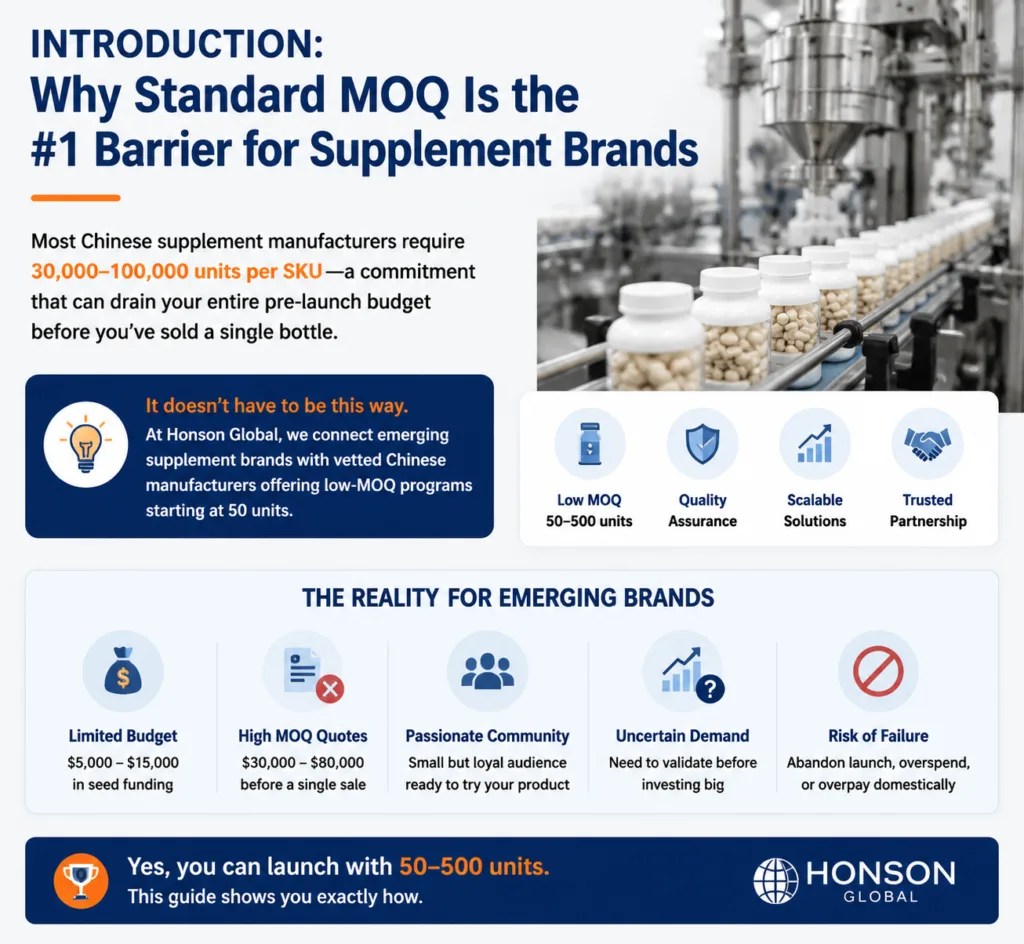
When you’re launching a new supplement line with $5,000–15,000 in seed funding, the last thing you need is a manufacturer asking you to commit $30,000–80,000 before you’ve sold a single bottle.
This is the reality for most emerging DTC supplement brands approaching Chinese manufacturers. The standard MOQ in China for capsules, tablets, or gummies typically ranges from聽30,000 to 100,000 units per SKU—a commitment that can easily consume your entire pre-launch budget before you’ve validated whether customers will actually buy your product.
At Honson Global, we hear this story dozens of times a month: a founder with a brilliant formulation, a small but passionate community of early followers, and a manufacturer quote that’s completely out of reach. The brand either abandons the launch, settles for a domestic manufacturer with higher unit costs, or burns their entire product budget on a single production run.
It doesn’t have to be this way.
We’ve built our entire sourcing model around the needs of emerging brands—brands that need聽low MOQ supplement manufacturing with genuine quality assurance聽and the flexibility to scale on their own timeline. If you’re an early-stage DTC brand wondering whether it’s realistic to get production started with 50–00 units, the answer is: yes, absolutely. And this guide shows you exactly how to do it.
At Honson Global, we specialize in connecting emerging supplement brands with vetted Chinese manufacturers who offer genuine low-MOQ programs—starting at 300 units for certain formats, with the infrastructure to scale to 500, 5,000, and beyond as your brand grows.
Part 1: Understanding the Real MOQ Landscape in Chinese Supplement Manufacturing
Before you start negotiating, you need to understand why standard MOQs are so high and what your actual options are.
Why Small-Batch Manufacturing Is Growing
The rise of direct-to-consumer brands, shorter product life cycles, and faster ingredient trends has pushed more factories to offer small-batch programs. A growing number of founders now search specifically for a low MOQ supplement manufacturer China facility instead of assuming they need 30,000 units to start.
For the factory, small batches bring higher margins per unit and a pipeline of future orders. For the brand, they bring flexibility and speed. That mutual interest is why genuine low MOQ supplement manufacturer China programs keep multiplying every year.
Early validation also changes how you raise capital. A founder with real sales data from a 500-unit pilot is a much stronger fundraising story than a founder with a spreadsheet. That is the quiet superpower of low MOQ supplement manufacturer China partnerships: they turn assumptions into evidence.
Why Do Chinese Supplement Manufacturers Set High MOQs?
The high minimum order quantities at most Chinese supplement factories aren’t arbitrary. They’re rooted in genuine production economics:
1. Equipment Changeover Costs
Every time a factory switches from one product to another, they incur significant changeover costs:
- Machine teardown and reconfiguration: 4– hours of downtime
- Line cleaning (critical for allergen control): 2– hours
- Recalibration and quality testing: 3– hours
- First-batch waste (typically 500–,000 units per SKU)
For a mid-size Chinese supplement factory running at 75–5% capacity utilization, changeovers represent聽direct lost revenue. An 8-hour changeover on a production line capable of 40,000 capsules/hour means losing 320,000 units of potential output. Factories protect against this by bundling changeover costs into MOQ requirements—asking you to produce enough units in a single run to make the setup worthwhile for them.
2. Raw Material Sourcing Economics
Chinese supplement manufacturers typically source raw materials in bulk quantities:
- Active ingredients (extracts, minerals, vitamins): minimum 25–00kg batches
- Capsules and excipients: minimum 100–00kg batches
- Packaging materials: minimum 5,000–0,000 units
If you’re only ordering 500 units, the raw material cost per unit is disproportionately high because you’re paying for partial batches.
3. Quality Control Overhead
FDA-registered and cGMP-certified Chinese factories maintain strict QC protocols:
- Incoming material inspection (every batch)
- In-process checks (every 2– hours during production)
- Finished product testing (COA required for every run)
- Stability testing (for custom formulations)
These overhead costs are amortized across production volume. Small runs carry the same QC overhead as large runs, making them less economically attractive to manufacturers.
What the “Standard MOQ”Actually Hides
Here’s what most sourcing guides won’t tell you:聽MOQ numbers are almost always negotiable—but they’re structured differently depending on what you’re willing to commit.
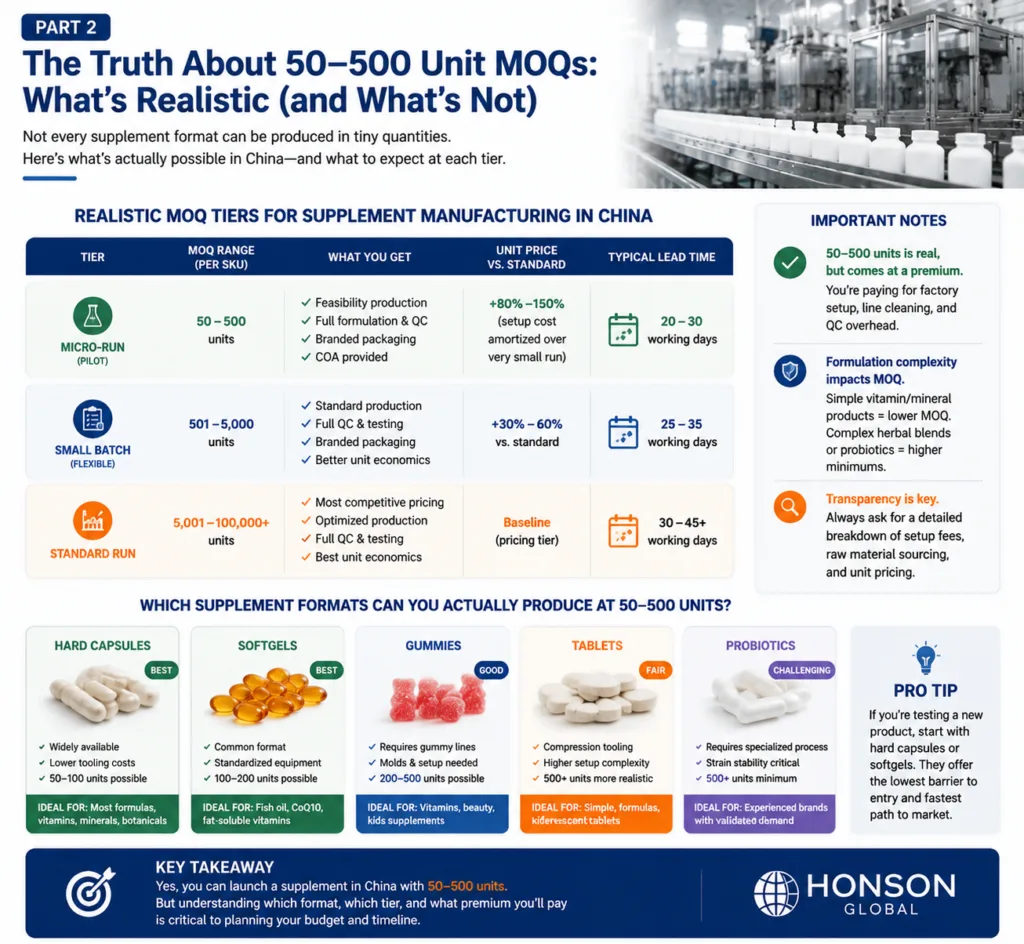
At Honson Global, we typically see three tiers of MOQ arrangements:
| Tier | MOQ Range | What’s Actually Included | Best For |
|---|---|---|---|
| Standard Run | 30,000–00,000 units | Full production pricing, no setup fees mentioned | Established brands with validated demand |
| Flexible/Small Batch | 5,000–5,000 units | Higher unit price, explicit setup fee structure | Brands launching 2– SKUs |
| Micro-Run / Pilot | 50–,000 units | Significant unit price premium, dedicated setup | Brands testing 1– SKUs with limited budget |
The third tier”strong>50–00 units—is the one most brands assume doesn’t exist in China. It does, but it’s structured differently. At Honson Global, we’ve negotiated micro-run programs with our partner factories specifically for emerging DTC brands who need to validate before they commit.
How Low MOQ Supplement Manufacturer China Programs Are Structured
Every low MOQ supplement manufacturer China program looks slightly different, so it pays to understand the common structures before you negotiate:
- Stock formula pilot runs: existing formulas with your label, usually the lowest entry point.
- Modified formula micro-runs: minor adjustments to flavor, dosage, or format with a dedicated setup fee.
- Custom formula pilot batches: full development work, longer timelines, and higher per-unit cost.
- Staggered production schedules: multiple small batches planned over time at improved pricing.
When you compare quotes, ask each low MOQ supplement manufacturer China candidate to explain exactly what is included in the setup fee, how many units the price covers, and what changes when you scale.
MOQ Benchmarks by Dosage Form
MOQ varies by production method. Use these benchmarks as a starting point when you evaluate a low MOQ supplement manufacturer China quotation:
- Capsules: 300-500 units for stock formulas on pilot lines
- Tablets: 1,000-5,000 units depending on tooling
- Gummies: 500-2,000 units with dedicated molds
- Powders and stick packs: 500-3,000 units
- Liquids: 500-2,000 units
- Softgels: 1,000-5,000 units
Formats that require custom tooling, such as gummy molds or tablet punches, carry higher minimums because the tooling cost must be spread across the batch. A flexible low MOQ supplement manufacturer China facility will explain these trade-offs before you commit.

Part 2: The 5 Key Benefits of Low-MOQ Supplement Manufacturing
The benefits of low MOQ programs go beyond the order size itself. When you work with a low MOQ supplement manufacturer China, you are buying flexibility, data, and optionality: the ability to change direction while your cash is still safe. The benefits below are the ones founders mention most often.
Benefit 1: Validate Before You Commit
The biggest risk in launching a new supplement product is investing $40,000–80,000 in inventory before you know whether customers will buy. Low MOQ flips this risk.
With a 50–00 unit pilot run:
- You can launch a single SKU for $2,000–8,000 total (including product, packaging, and shipping)
- Get 50–00 real customers using your product in the real world
- Collect genuine feedback on formula, packaging, and pricing
- Make data-driven decisions about scaling before spending $40,000+
At Honson Global, we structure pilot runs for our clients with a聽formal transition plan: if the pilot sells through at a rate you define together, we transition to a larger production run (5,000–0,000 units) at improved pricing. This lets you de-risk the launch entirely.
Benefit 2: Test Multiple SKUs Simultaneously
With a 50,000-unit standard MOQ, you’re committing $50,000+ to a single SKU before you know if it will work. You can’t afford to test multiple formulations.
With low-MOQ manufacturing:
- Test 3– different supplement concepts simultaneously with $5,000–15,000 total
- Let real market feedback guide your SKU decisions
- Kill products early when they don’t resonate (cheap) versus after you’ve invested $50,000 (expensive)
- Build a product roadmap based on actual sales data, not gut feelings
Benefit 3: Reduce Cash Flow Risk
For early-stage DTC brands, cash is your most precious resource. Tying $40,000–80,000 in inventory leaves you unable to invest in marketing, brand development, or operational infrastructure.
| Scenario | Units | Cash Committed | Remaining for Marketing |
|---|---|---|---|
| Standard MOQ | 50,000 | $40,000 | $10,000 |
| Low MOQ (Pilot) | 500 | $3,500 | $46,500 |
| Low MOQ (Small Batch) | 5,000 | $12,000 | $38,000 |
Benefit 4: Respond to Market Trends Faster
The supplement industry moves fast. With a 50,000-unit MOQ, you’re locked into a 3– month production cycle where you can’t react to market changes.
Low-MOQ manufacturing lets you respond to ingredient trends, competitor launches, and customer feedback in weeks instead of months. That speed is one of the strongest reasons emerging brands choose a low MOQ supplement manufacturer China offers at the pilot stage.
Benefit 5: Protect Cash for Marketing and Growth
Every dollar tied up in inventory is a dollar you cannot spend on the marketing that actually drives sales. A low MOQ supplement manufacturer China program keeps your initial cash commitment small, so your ad budget, content production, and community building stay fully funded during the launch window.
In practice, founders who start with 300-500 units reinvest the savings into customer acquisition, iterate on their offer, and build momentum before committing to a larger production run. By the time they scale, they have sales data instead of guesses.
Benefit 6: Build Supplier Relationships That Scale With You
A low MOQ supplement manufacturer China partnership is not a one-off transaction. When you start small, you prove that you are a serious, organized buyer, and the factory learns your product specifications, quality standards, and packaging preferences.
Brands that start with micro-runs often receive better pricing, shorter lead times, and priority production slots as they grow. The relationship with a low MOQ supplement manufacturer China compounds over time: the factory invests in your success because your growth is their growth.
How to Make the Most of a Pilot Run
A pilot run from a low MOQ supplement manufacturer China is only valuable if you use it to learn. Define success metrics before you order: sell-through rate, repeat purchase rate, and customer feedback on formula and packaging.
Share the results with your manufacturing partner. Factories that see real sales data from your pilot are far more willing to negotiate better pricing on the next run, and your next order from the same low MOQ supplement manufacturer China becomes a bigger, better-informed commitment.
Part 3: How to Evaluate a Low MOQ Supplement Manufacturer China
Not every factory that advertises low MOQs can actually deliver quality at small scale. Use the same evaluation framework you would apply to any supplier, with extra attention to the items below.
Check Whether the Low MOQ Is Real or a Sales Hook
Some suppliers quote a low MOQ and then quietly raise the effective minimum through minimum spend requirements, mandatory premium packaging, or large sample fees. Ask directly: what is the smallest order you can place, and what is the total cost of that order including packaging and testing?
A genuine low MOQ supplement manufacturer China program gives you a clear, itemized quotation for a small batch. If the numbers change after you commit, walk away.
Verify Quality Systems, Not Just Price
Small production runs should still follow cGMP principles: incoming raw material checks, in-process controls, finished product testing, and certificates of analysis. Confirm which documents you will receive with every batch from your low MOQ supplement manufacturer China partner.
You can cross-check ingredient and labeling requirements against official sources such as the U.S. Food and Drug Administration (FDA dietary supplements) and the National Institutes of Health (NIH Office of Dietary Supplements).
Review the Pilot-to-Scale Transition
The best low MOQ supplement manufacturer China partnerships include a clear scaling path: agreed pricing at 500, 5,000, and 20,000 units, plus lead times and reorder procedures. Without a transition plan, you may face a completely new negotiation every time you reorder.
What to Ask a Low MOQ Supplement Manufacturer China Before You Order
Prepare a short list of questions before your first call. The answers separate real programs from marketing noise:
- What is the true minimum order for my dosage form and formula?
- What is included in the quoted price: packaging, labeling, testing, shipping?
- What certifications does the facility hold for my destination market?
- Can you provide samples from the exact line that will produce my order?
- What happens if the pilot batch fails quality inspection?
- What is the pricing ladder at 500, 5,000, and 20,000 units?
- What documentation will I receive with each batch?
Ask each low MOQ supplement manufacturer China candidate the same questions in writing. Consistent, itemized answers make comparison easy and reveal which suppliers are organized.
How Costs Break Down in a Low MOQ Program
Small batches carry proportionally higher setup costs. A typical 500-unit pilot from a low MOQ supplement manufacturer China includes these components:
- Setup and changeover fees: cover line cleaning and reconfiguration
- Raw materials: priced at partial-batch rates
- Manufacturing labor: small runs are less efficient per unit
- Packaging: bottles, labels, and cartons at small-order prices
- Testing: the same COA scope as a large run
- Freight: air or sea options depending on volume and timeline
Ask every low MOQ supplement manufacturer China candidate to show these line items separately. You want to know exactly where your money goes, especially in the first order.
How to Negotiate a Low MOQ Program
Negotiation with a low MOQ supplement manufacturer China starts long before the price discussion. Begin by sharing your full product brief, including target market, dosage form, and growth plans. Factories are far more flexible when they see a serious roadmap behind the first small order.
Useful negotiation levers include committing to a second batch within a defined period, accepting a longer lead time, choosing a standard formula, or paying a deposit that covers setup costs. Every concession you make can be exchanged for a lower MOQ or a better unit price.
Always get the final agreement in writing: MOQ, unit price, setup fee, lead time, testing scope, and reorder pricing. A professional low MOQ supplement manufacturer China will put all of it on paper without hesitation.
Common Mistakes When Choosing a Low MOQ Supplement Manufacturer China
- Chasing the absolute lowest per-unit price while ignoring setup fees and quality
- Ordering a custom formula before validating demand with a stock formula
- Skipping third-party testing to save a few hundred dollars
- Approving packaging artwork without checking marketplace requirements
- Committing to a large run because the per-unit price drops
These mistakes are easy to make under launch pressure. A disciplined process, applied to every low MOQ supplement manufacturer China candidate, prevents most of them.
Final Thoughts: Start Small, Learn Fast, Scale With Confidence
Low MOQ manufacturing exists because the supplement market rewards founders who test, learn, and iterate. A low MOQ supplement manufacturer China partnership lets you validate your product with real customers before you commit serious capital.
Choose a partner that combines genuine small-batch capability with documented quality systems and a clear scaling path. That combination is what turns a pilot run into a lasting brand.
Frequently Asked Questions About Low MOQ Manufacturing
Can I really start with 300 units? Yes, for certain formats and stock formulas. Capsules and powders on pilot lines are the most common entry points for low MOQ supplement manufacturer China programs.
Are low MOQ products more expensive per unit? Yes, small batches carry higher per-unit costs because setup and testing are spread over fewer units. The trade-off is worth it when you are validating demand.
Will quality suffer with a small batch? Not if you choose the right partner. Quality systems should be identical regardless of batch size; confirm the COA and inspection scope in writing before you order from any low MOQ supplement manufacturer China.
Ready to start? Request a quote with your product concept and target market, explore our OEM and ODM supplement services, or read how our process works. You can also learn more about choosing a dietary supplement OEM manufacturer in our related guide.